Straight answers before the drill comes out
26 real questions from Arizona homeowners, HOA boards, and facility managers — costs, methods, caliche, and the monsoon.
Cost
Real numbers up front — because nobody else in this industry publishes them.
Most residential projects land between roughly $661 and $1,868, with an average around $1,200; small single-slab lifts can run as little as ~$325. Price is driven by how far the slab has sunk and how much material the voids swallow, not just square footage — which is why we quote from an on-site inspection.
Polyurethane lifting typically runs $5–$25 per square foot depending on lift height and void volume, versus $3–$6 for old-style mudjacking. Foam costs more per foot but lasts decades instead of 5–10 years, so it's usually cheaper per year of service.
Almost always — leveling generally runs far less than tear-out and re-pour, and you keep your existing finish (Kool Deck, stamping, exposed aggregate) that new concrete can never match. Replacement also means demo mess, weeks of cure time, and in Arizona, jackhammering through caliche.
A typical ~450 sq ft two-car driveway runs about $1,500–$3,000 with mudjacking or $3,200–$7,500 with polyurethane, depending on settlement depth. Full driveway replacement is routinely two to four times the cost of lifting.
Leveling ~100 sq ft of sidewalk typically runs $320–$650 by mudjacking or $650–$2,700 with foam — usually a few hundred dollars per raised flag. That's a fraction of what one trip-and-fall lawsuit or a city-ordered repair bill can cost a property owner.
No — inspections and quotes are free statewide. We measure actual settlement, sound for voids, and give you a fixed price before any drilling starts.
Methods: Poly vs Mud vs Replacement
The comparison every Arizona homeowner should see before signing anything.
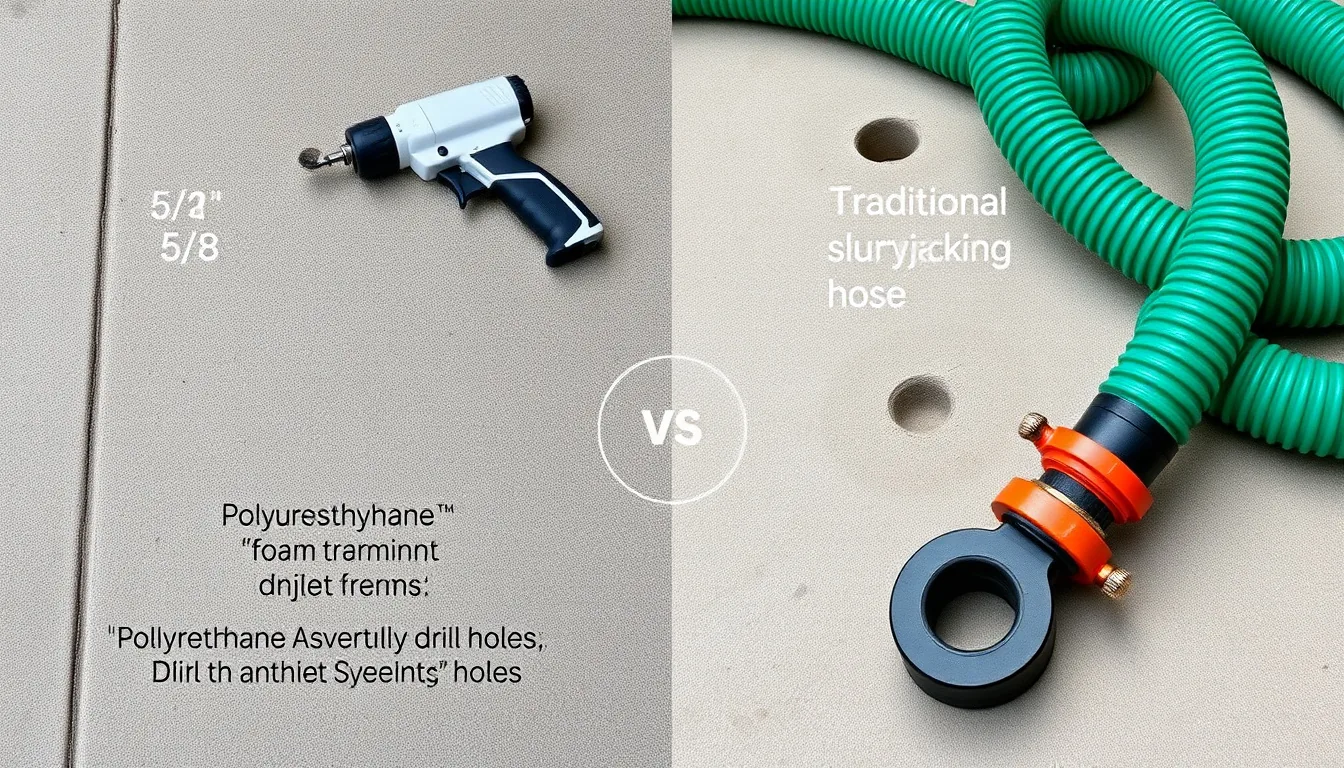
Mudjacking pumps a heavy cement-and-soil slurry through 1–2 inch holes and needs 1–3 days to cure; polyjacking injects expanding polyurethane foam through 5/8-inch holes and cures in about 15 minutes. Foam weighs about 2 lb per cubic foot versus 100+ lb for slurry, so it doesn't re-load the weak soil that caused the sinking.
The foam reaches roughly 90% strength in about 15 minutes; you can walk on it immediately after we finish and drive on it the same day. Mudjacking slurry, by contrast, typically needs 24–72 hours before traffic.
About 5/8 of an inch — the size of a dime — patched with color-matched mortar. Mudjacking requires 1–2 inch holes, which stay visible, especially on decorative finishes.
The foam is inert, closed-cell, and waterproof — it doesn't shrink, rot, or wash out, so the lift itself is effectively permanent. Mudjacking slurry commonly fails in 5–10 years because it's heavy and erodible; if soil keeps moving under any repair, the cause is soil and drainage, which we address at the same visit.
When the slab itself is destroyed — shattered into small pieces, badly spalled, or built too thin — lifting a broken slab just levels the rubble. We'll tell you honestly; roughly, if a slab is cracked into more than a few large sound pieces, replacement wins.
Once reacted (in seconds), the polyurethane is inert and doesn't leach into soil or water — the same chemistry is used under municipal roads and around utilities. It's also waterproof, so monsoon water can't dissolve it the way it erodes mud slurry.
Arizona Soil & Climate
Caliche, collapsible soil, fissures, monsoon — the desert-specific answers.
Most desert valley soils are collapsible alluvial deposits — loose sediment that stands firm while bone-dry, then compacts suddenly the first time irrigation, a plumbing leak, or monsoon rain soaks it. Add caliche hardpan that makes slabs bear unevenly, and regional ground subsidence from groundwater pumping, and Arizona slabs settle differently than anywhere else in the country.
Caliche is a natural calcium-carbonate 'desert concrete' layer common under Phoenix and Tucson soils. Slabs poured over hard caliche lenses next to softer pockets settle unevenly — and caliche makes excavation for replacement brutal, which is a big reason lifting beats re-pouring here.
Yes — the June 15–September 30 monsoon delivers roughly a third of Phoenix's annual rain (about 2.5 inches) and nearly half of Tucson's (about 6 inches) in violent bursts. That water scours base material from under slab edges, funnels down roof scuppers onto patios and driveways, and triggers first-time collapse of dry desert soils.
Earth fissures are ground cracks caused by basin subsidence from decades of groundwater pumping; Arizona has about 169 miles of mapped fissures across Maricopa, Pinal, Pima, Cochise, and La Paz counties, and over 3,000 square miles of land has measurably sunk. Most settled slabs are NOT fissure-related — but we check the AZGS hazard maps, and if your property is in a fissure study area we'll say so before recommending anything.
Summer slab surfaces get hot enough to drive expansion-contraction cycles that open joints and cracks, which then let monsoon water reach the soil below. Heat also complicates new pours — rapid moisture loss, shrinkage cracking — one more reason repairing an existing sound slab beats replacing it in an Arizona summer.
Fast-growth communities like Queen Creek and Buckeye are built on engineered fill that's compacted for the foundation, but flatwork — driveways, patios, walks — often sits on backfilled utility trenches and loosely returned soil at the lot edges. That fill consolidates in the first 2–7 years, which is exactly when driveways and patios start dropping.
Process & Durability
What actually happens on lift day, and how long it holds.
We map the settlement with a level, drill a pattern of 5/8-inch holes, inject expanding foam in controlled lifts while monitoring with gauges, then patch the holes and seal open joints. Most residential jobs are done in 1–3 hours and the slab is usable the same day.
Yes — the foam reacts underground and isn't weather-dependent the way pouring new concrete is, so we work year-round, including monsoon season and 110-degree afternoons. The one thing weather changes is scheduling around active storm cells for crew safety.
We lift in small, monitored increments precisely to avoid that; existing hairline cracks may flex slightly, but controlled foam injection is far gentler than the original settlement was. Slabs already broken into many pieces get an honest replacement recommendation instead.
Both — every lift includes joint and crack sealing, and we flag the water source feeding the settlement (scupper discharge, drainage slope, irrigation, suspected leak). Fixing drainage is what makes the repair permanent on Arizona's water-sensitive soils.
Commercial, Safety & ADA
Trip hazards, ordinances, and downtime — for facility managers and HOA boards.
Any vertical change of 1/4 inch or more in a walking surface is a trip hazard under ADA standards; edges between 1/4 and 1/2 inch must be beveled at 1:2, and anything over 1/2 inch requires re-leveling or a ramp. We lift sidewalk flags back to within tolerance and document the correction for your records.
In Phoenix, the abutting property owner is: City Code §31-55 makes owners liable for injuries caused by defective sidewalks along their property, and §31-57 lets the City perform the repair and bill the owner if they don't act. Scottsdale, Tempe, Mesa and other Valley cities have similar ordinances — proactive leveling is dramatically cheaper than a trip-and-fall lawsuit or a city work order.
Almost none — foam cures in about 15 minutes, so we can lift a warehouse aisle, storefront walkway, or drive lane overnight and hand it back at full load capacity by morning. Compare that with 24–72 hours for slurry cures or a week-plus closure for demolition and re-pour.
Yes — rocking joints are usually voids, not failed concrete; we inject foam to fill the void and stabilize the slab so it stops pumping and spalling at the joints. This protects forklifts, product, and workers, and costs a small fraction of joint reconstruction.
Question we didn't cover?
Call 844-967-5247 and ask a crew lead directly — or send it through the contact form and get an answer within a business day.