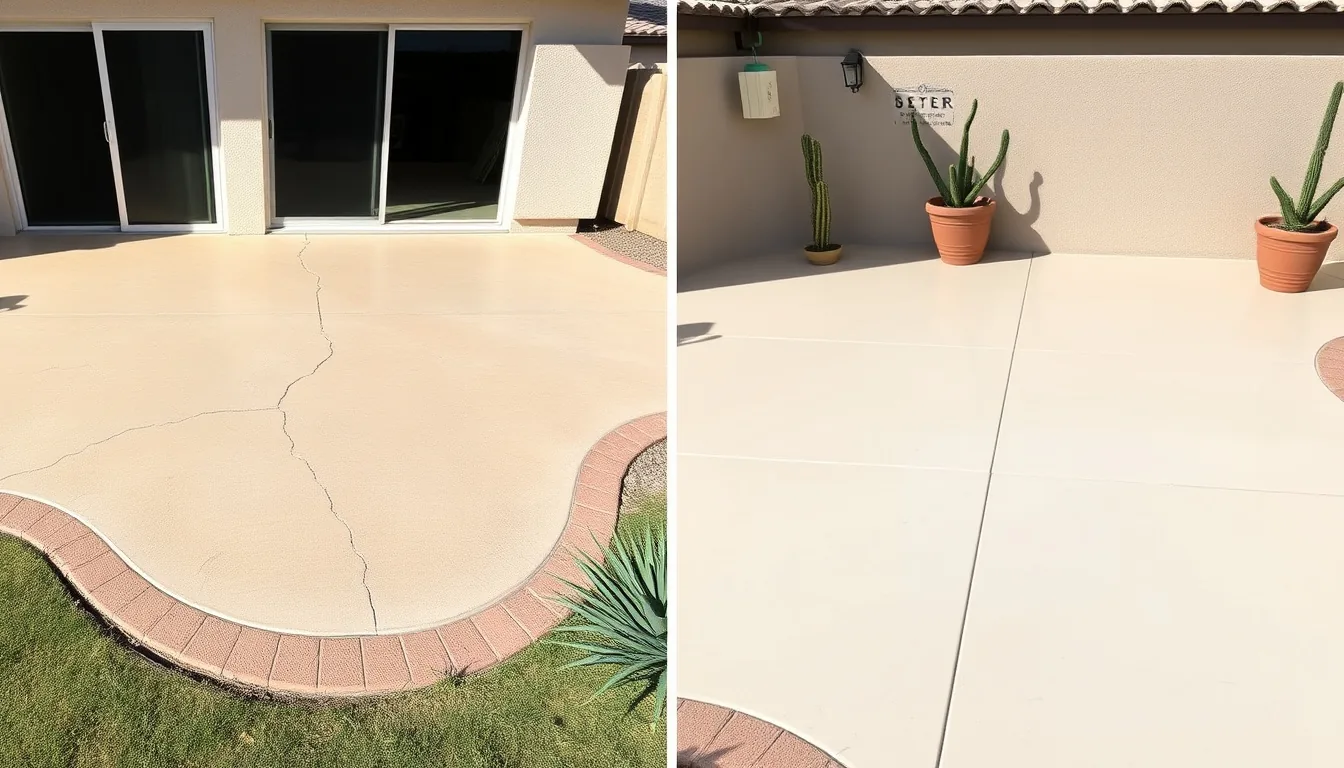
PATIO LIFTING & LEVELING
Patio Leveling in Arizona — Lift Sunken Patios and Restore Drainage Away From Your Home
Arizona patios do not just sink — they tilt toward the house and drain monsoon rain against your foundation. We lift them back to positive slope in hours, with dime-size holes and a 15-minute cure.
The Real Danger of a Sunken Patio: Water Draining Toward Your House
The number-one patio problem we see across Arizona is not the cracks or the tripping edge — it is the direction of the tilt. When a patio settles, it almost always settles at the house side, because that is where the loosest soil sits. The slab develops negative slope, and every monsoon storm from June 15 through September 30 sends water running toward the stem wall instead of away from it.
That reversed drainage is a compounding problem. Water that pools against a slab-on-grade Arizona home soaks the soil under the footing, feeds further settlement, invites moisture into the termite inspection gap, and works on the very foundation the patio is attached to. A patio that has dropped an inch is not a cosmetic issue — it is a drainage system pointed the wrong way.
Leveling corrects the geometry at the source. We lift the slab back to positive slope so roof runoff and storm water shed away from the house the way the original builder intended, usually in a single morning of work. The repair also closes the widening gap at the stem wall and takes the standing-water pressure off the footing before the next storm cycle arrives.
Symptoms: How Arizona Patios Tell You They Are Settling
Patio settlement rarely announces itself with one dramatic crack. It creeps in over a few seasons, and most homeowners notice the secondary symptoms before they notice the slope itself. Set a level on the slab, or just watch where water sits after a storm — puddles hugging the house wall are the classic early warning.
Heavy point loads make it worse. Built-in BBQ islands, spas on the slab corner, and ramada or covered-patio posts concentrate weight onto small footprints, and on Arizona's collapsible soils those footprints punch downward first, producing a patio that settles unevenly rather than as one plane. If your patio table wobbles in a spot where it used to sit flat, that differential movement is usually the reason.
- Water ponding against the house wall after monsoon storms
- A widening separation gap between the patio slab and the stem wall
- Cracks radiating from BBQ island, spa, or ramada post footprints
- Door thresholds out of alignment where the patio meets the house
- Hollow sound when you tap the slab near the settled edge
- Expansion joints opening up or dropping in a stair-step pattern
Why Patios Settle: The Least-Compacted Soil on Your Lot
When your home was built, the excavation around the foundation was backfilled after the stem wall cured — and that backfill against the house is routinely the least-compacted soil anywhere on the lot. The patio was then poured directly over it. Dry, that loose fill holds shape for years. Arizona's alluvial soils are collapsible: they stand firm until they get wet for the first time, then consolidate suddenly.
The water arrives on a schedule. Arizona roofs drain through scuppers and canales that dump concentrated streams right at the patio edge — there are no gutters wrapping most desert homes to carry it away. Add drip irrigation lines run along the patio border and monsoon bursts that deliver roughly a third of Phoenix's annual rain in a few violent weeks, and the loose backfill under your patio gets soaked, collapses, and takes the slab down with it.
That is why a patio can behave for fifteen years and then drop noticeably in a single summer. The soil was not stable — it was just dry. One new drip line along the border, one re-routed downspout, or one unusually wet monsoon is enough to trigger the first-wetting collapse that has been waiting underground since the house was built.
How We Lift a Patio: Small Holes, Precise Slope, Same-Day Use
We start by mapping the settlement with a level so we know exactly how far each part of the slab has dropped and what the finished plane needs to look like. The target is not just flat — it is positive slope, roughly a quarter inch per foot falling away from the house, so drainage works permanently.
Then we drill a pattern of 5/8-inch holes — about the size of a dime — and inject expanding polyurethane foam beneath the slab in small, monitored lifts. The foam fills the voids the collapsed soil left behind, then raises the concrete gently back to grade. It reaches roughly 90 percent strength in about 15 minutes.
Holes are patched with color-matched mortar, and your patio furniture goes back the same afternoon. Most residential patio lifts are complete in one to three hours, with no demolition, no concrete trucks in the backyard, and no week of cure time. The lift is watched with gauges the entire time, so the slab rises as one controlled plane instead of flexing at its weak points.
The Add-On That Makes It Permanent: Sealing the House-Slab Joint
Lifting the slab fixes the elevation. Sealing the joints fixes the cause. The gap where the patio meets the house is the main feeding tube for the water that collapsed the soil in the first place — every storm and every irrigation cycle sends moisture straight down that seam into the backfill. Leaving it open guarantees the soil keeps consolidating.
On every patio lift we caulk the house-slab joint and any open cracks or expansion joints with a flexible sealant built for Arizona's temperature swings, where slab surfaces can reach 140 to 160 degrees in summer and joints move constantly. Cutting off the water supply is what keeps the repair from ever needing to be repeated.
We will also flag drainage contributors while we are there: a scupper discharging onto the slab edge, a drip line running against the border, a downspout with no splash block. Small corrections, big difference on water-sensitive desert soil. Most of these fixes cost almost nothing compared to the leveling itself, and together they starve the settlement of the water it needs to continue.
Leveling vs Replacement: The Cost Math and What You Get to Keep
Concrete leveling generally runs a fraction of tear-out and re-pour — across Arizona, typical residential lifting projects land between roughly $661 and $1,868, while full replacement of the same patio routinely costs two to four times what lifting does. Replacement also means demolition mess in a finished backyard, jackhammering through caliche, haul-off, forming, pouring, and days of cure time before you can set foot on it.
Leveling also preserves what replacement destroys. Pavers and travertine laid over a concrete base, acrylic coatings, stamped and colored finishes — none of these can be matched by a new pour. We lift the slab underneath them and the finish comes along intact. For homeowners who invested in a decorative surface, that preservation alone often justifies leveling over replacement before the cost comparison even starts.
And a new slab poured on the same collapsed backfill inherits the same problem. Unless the soil and drainage are corrected, replacement resets the clock without fixing the mechanism. Lifting plus joint sealing addresses both at once. You pay once to fix the elevation and the water path together, instead of paying twice for a new slab that repeats the old failure.
When Patio Settlement Signals Something Bigger
Most sunken patios are exactly that — a floating exterior slab that dropped on collapsed fill. But sometimes patio movement is the visible edge of a larger issue: foundation movement in the stem wall it abuts, or, in mapped parts of Maricopa, Pinal, and Pima counties, proximity to earth-fissure study areas where basin subsidence is at work.
We tell you which one you have. If the cracking pattern, the stem wall, or the AZGS hazard mapping suggests structural or geologic movement rather than simple slab settlement, we say so plainly and point you to a structural engineer before recommending any injection work. Lifting a patio is the right fix for the right problem — and we would rather send you to the right specialist than sell you the wrong repair.
Patio Leveling Anywhere in Arizona — Free On-Site Estimates
We level patios statewide: across the Phoenix metro from Scottsdale to Buckeye, in fast-growing Queen Creek and Gilbert subdivisions where builder backfill is hitting its settlement years, in Tempe and Mesa flood-irrigation neighborhoods where soils get saturated on a schedule, and down to Tucson, where the monsoon delivers nearly half the year's rain. Flagstaff, Prescott, and Yuma are on the dispatch map as well.
Estimates are free and happen on-site — we measure the actual settlement, sound for voids, check the drainage picture, and hand you a fixed price before a single hole is drilled. If your patio is tilting toward the house, the best time to correct it is before the next monsoon season loads the soil again. Call or send photos and we will tell you exactly what you are looking at.
Patio Leveling FAQs
Straight answers before we drill
The backfill placed against your foundation during construction is the least-compacted soil on the lot, and Arizona's alluvial soils collapse the first time they get thoroughly wet. Roof scuppers, drip irrigation, and monsoon rain concentrate water exactly at that edge, so the house side of the patio drops first and the slab tilts toward the stem wall.
We map the settlement with a level, drill a pattern of 5/8-inch holes, inject expanding foam in small monitored lifts until the slab is back to positive slope, then patch the holes with color-matched mortar and seal the open joints. Most patio jobs take one to three hours and the slab is usable the same day.
Almost always — leveling generally runs a fraction of tear-out and re-pour, and replacement is routinely two to four times the cost of lifting. You also keep decorative finishes like pavers, travertine, and stamped or colored concrete that a new pour can never match, and you skip demolition mess and days of cure time in a finished backyard.
Both. Every patio lift includes caulking the house-slab joint and sealing open cracks so monsoon water and irrigation stop feeding the soil below, and we flag the water source driving the settlement — scupper discharge, negative grading, or a drip line running along the slab edge. Fixing the water path is what makes the repair permanent on Arizona soils.
Sunken concrete? Get it lifted this week.
Free estimates statewide. Most residential lifts finished in under a day — driveable in 15 minutes.