Sidewalk Leveling — Statewide Arizona
Sidewalk & Walkway Leveling in Arizona — Remove Trip Hazards Before They Become Lawsuits
A quarter-inch edge is a documented trip hazard. In Phoenix, it's the adjacent property owner's problem — not the city's. We lift sidewalk flags back to tolerance in under an hour each.
The quarter-inch rule: when a sidewalk becomes a hazard
Under ADA accessibility standards, any vertical change of 1/4 inch or more in a walking surface is a trip hazard. Edges between 1/4 and 1/2 inch only pass if they're beveled at a 1:2 slope, and anything over 1/2 inch requires re-leveling or a ramp. Those aren't suggestions — they're the measurements an inspector, a plaintiff's attorney, or a city code officer will put in a report.
Most raised sidewalk edges in Arizona sit in exactly that 1/4-to-1-inch band: too small to look dramatic, exactly big enough to catch a toe. We lift each affected flag back to within tolerance and document the correction with before-and-after measurements.
In Phoenix, the sidewalk is your legal problem — not the city's
Most homeowners assume the city owns sidewalk defects. In Phoenix, City Code §31-55 puts responsibility for injuries caused by defective sidewalks on the abutting property owner — and §31-57 lets the City perform the repair itself and bill you if you don't act. Scottsdale, Tempe, Mesa, and other Valley cities have similar ordinances.
That changes the math completely. A raised flag along your frontage isn't a cosmetic annoyance; it's open legal exposure that costs a few hundred dollars to close. Leveling a sidewalk section typically runs a small fraction of what one trip-and-fall lawsuit — or one city-ordered repair at contractor-of-their-choosing rates — will cost.
Why Arizona sidewalks heave and sink
Three forces work on Valley sidewalks year-round. Tree roots — especially thirsty non-natives planted in parkways — lift flags from below. Irrigation along the parkway strip soaks collapsible desert soil that then compacts and drops the slab. And every monsoon, concentrated flow along curb lines scours base material out from under flags at curb cuts and driveway transitions.
The result is the classic Arizona sidewalk: one flag up half an inch from a ficus root, the next one down an inch from washout, all along the same frontage. Both directions of failure fix the same way — precision lifting to a common plane.
Pinpoint lifts, flag by flag
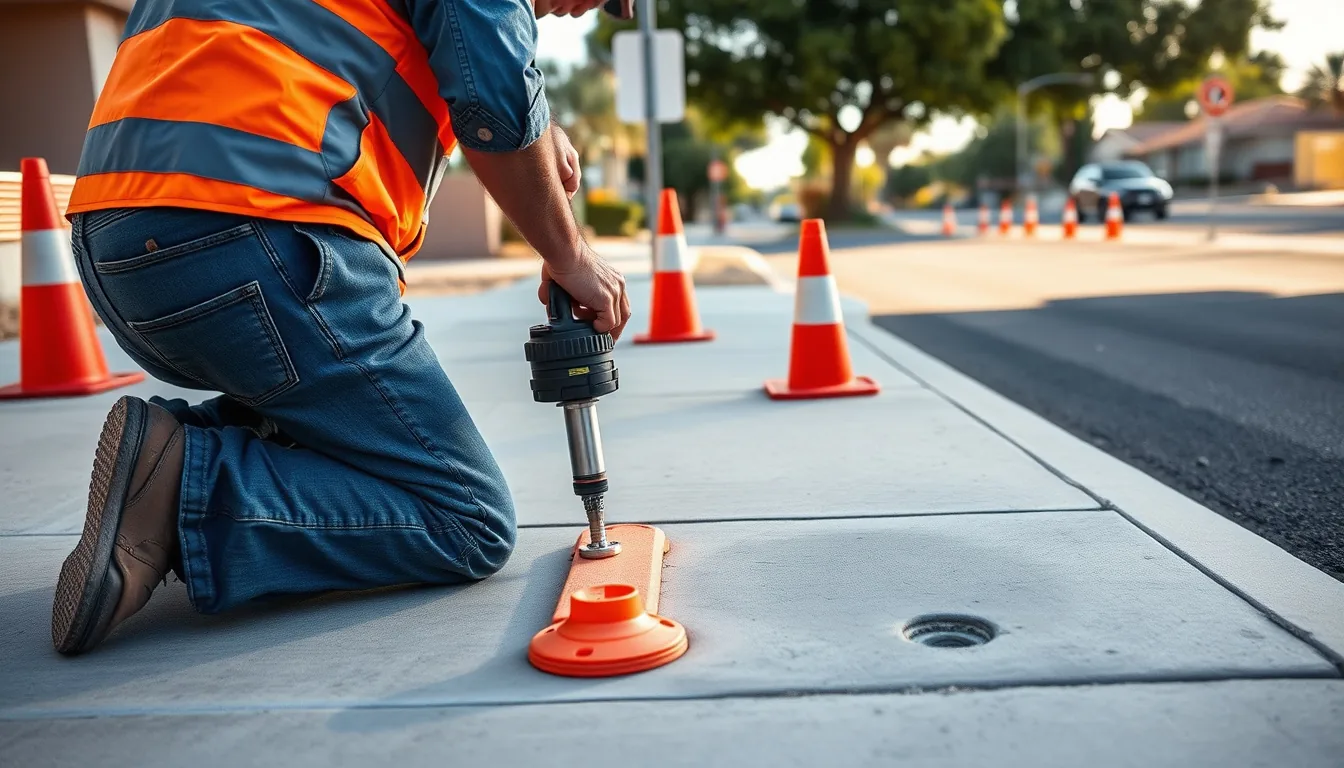
Sidewalk leveling is the most surgical work we do. Each flag gets one or two 5/8-inch holes, a metered shot of expanding foam, and a monitored lift measured against its neighbors — accuracy to within fractions of an inch. The foam cures in about 15 minutes, holes are patched with color-matched mortar, and the walkway takes foot traffic in under an hour.
There's no saw-cutting, no demo, no fresh gray patch that screams 'repair' down an otherwise uniform sidewalk. For root-heaved flags, we coordinate root pruning where feasible so the lift doesn't get undone by the same root next season.
What sidewalk leveling costs
Leveling roughly 100 square feet of sidewalk typically runs $320–$650 with mudjacking or $650–$2,700 with polyurethane, and most single-flag corrections land at a few hundred dollars. Compare that with tear-out: demolition, haul-off, forming, an ADA-compliant re-pour, days of cure — and in Phoenix, the possibility the city does it for you and sends the bill.
For property managers and HOAs, the smarter spend is systematic: survey the whole frontage or common-area network once, lift every edge at or over 1/4 inch, and keep a dated log. Documented proactive correction is exactly what demonstrates due diligence if someone ever does fall.
HOA and commercial walkway programs
HOA-dense communities across Gilbert, Chandler, and Queen Creek maintain miles of common-area walkways that hit settlement age all at once — the 2000s-era build-out is now 20+ years into consolidating fill. We run annual survey-and-lift programs for HOAs and commercial sites:
- Walk the full network and measure every vertical edge
- Prioritized hazard list: over 1/2 inch first, 1/4-to-1/2 inch next
- Fixed-price per-flag lifting, scheduled off-peak
- Dated correction log for board and facility records
- Re-survey after each monsoon season
Same-visit sealing so the fix holds
Every sidewalk lift includes joint caulking at the corrected flags so monsoon flow stays on top of the concrete instead of re-entering the base. Where curb-line scour caused the settlement, we point it out and, where practical, fill the eroded void back to the curb — because a leveled flag over an open void is a repair on a timer.
It's the same philosophy across everything we lift: correct the concrete, then close the water path that moved it.
Book a free trip-hazard walk-through
For homeowners: send photos of the raised edge and your city, and we'll quote most sidewalk lifts from the photos alone. For HOAs, property managers, and commercial sites: book a free walk-through — we'll measure every edge on the property and hand you a prioritized, fixed-price list.
Call 844-967-5247 or use the estimate form. Statewide dispatch, with crews across the Phoenix metro and Tucson weekly.
Sidewalk & Walkway Leveling FAQs
Straight answers before we drill
The abutting property owner. Phoenix City Code §31-55 makes owners liable for injuries caused by defective sidewalks along their property, and §31-57 lets the City repair the sidewalk and bill the owner. Scottsdale, Tempe, Mesa and other Valley cities have similar ordinances.
Any vertical change of 1/4 inch or more. Edges between 1/4 and 1/2 inch must be beveled at 1:2, and anything over 1/2 inch requires re-leveling or a ramp. We lift flags back within tolerance and document the correction.
Leveling about 100 sq ft of sidewalk typically runs $320–$650 by mudjacking or $650–$2,700 with foam — usually a few hundred dollars per raised flag. That's a small fraction of a trip-and-fall lawsuit or a city-ordered repair bill.
Under an hour per flag in most cases, and the walkway takes foot traffic almost immediately — the foam cures in about 15 minutes. A full HOA common-area program is typically scheduled in one or two off-peak days.
Sunken concrete? Get it lifted this week.
Free estimates statewide. Most residential lifts finished in under a day — driveable in 15 minutes.