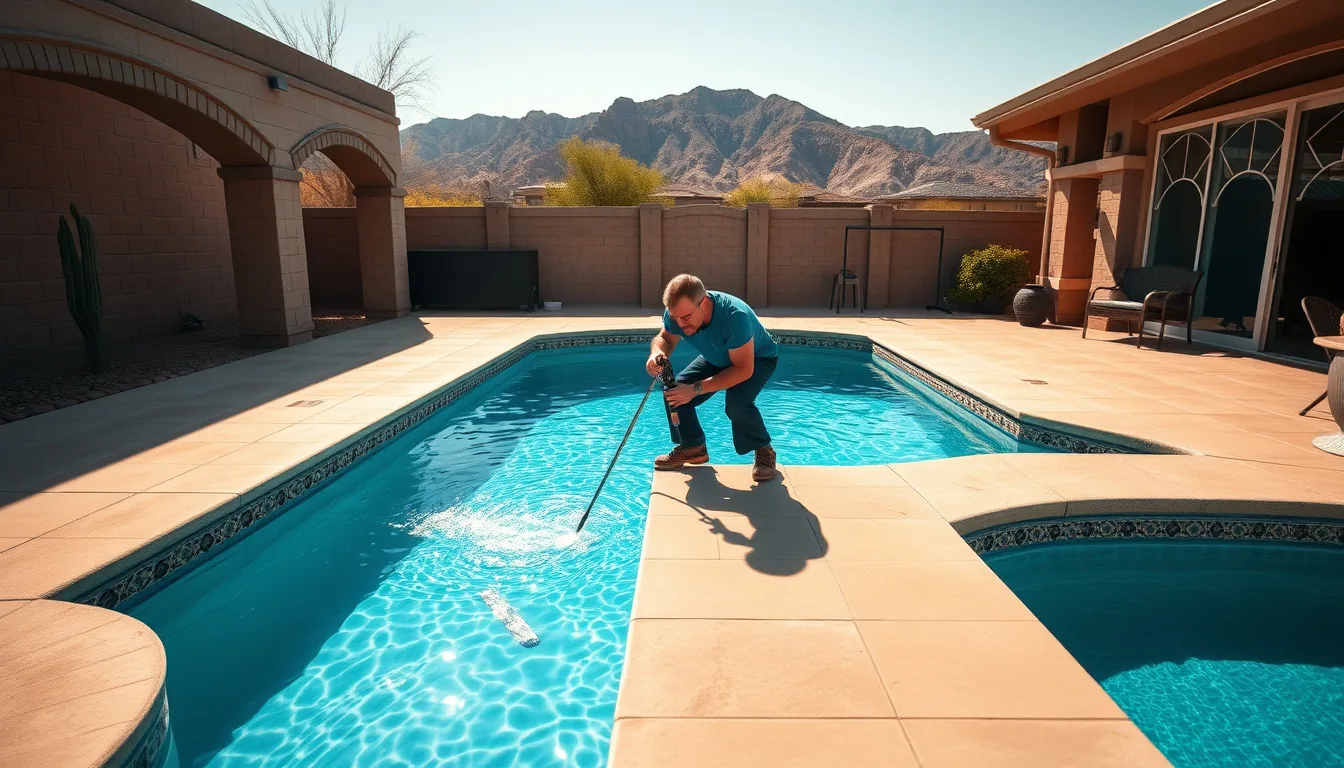
Pool Deck Lifting — Statewide Arizona
Pool Deck Lifting & Leveling in Arizona — Level Sunken Cool Deck Without Tearing Out Your Backyard
Arizona has the densest pool ownership in the country, and nearly every deck sits on backfilled excavation that settles. We lift decks level with lightweight waterproof foam — and you swim the same day.
Arizona's pool math: a state built on deck settlement
Roughly one in three Phoenix-area single-family homes has a pool — the highest concentration in the United States. Every one of those pools was dug as a hole bigger than its shell, and the gap around the shell — the over-dig — was backfilled with whatever came out of the ground, rarely compacted to the standard the deck deserves.
That makes pool decks Arizona's most predictable settlement casualty. The deck doesn't sit on native, undisturbed soil like your driveway does; it floats on loose backfill that consolidates a little more every time it gets wet. Which, around a pool, is constantly.
Why pool decks sink — and why it accelerates
Three water sources work the backfill under a deck: splash-out along the coping edge every swim season, deck drains that leak or discharge into the over-dig, and monsoon storms that overwhelm the drains entirely and dump sheets of water straight into the fill.
The settlement pattern is distinctive — slabs tilt toward the pool as the backfill nearest the shell consolidates first. That reverses the deck's drainage, sending water at the coping and under the shell instead of away from it, which accelerates the cycle. A deck that's dropped a half inch this year drops faster next year.
- Slabs tilting toward the water — reversed drainage
- Trip edges at expansion joints on a wet, barefoot surface
- Gaps opening under coping or at the deck-to-patio joint
- Deck-o-seal mastic torn or pulled away at joints
- Hollow sound when tapping near the pool edge
Why heavy slurry is exactly wrong here
Traditional mudjacking pumps 100-plus pounds per cubic foot of cement slurry on top of backfill that just proved it can't carry the deck it already had. Adding a hundred pounds of wet material per cubic foot of void over pool backfill is how you buy the same repair twice.
Polyurethane foam weighs about 2 pounds per cubic foot, cures closed-cell and waterproof, and won't wash into the over-dig during a storm. On pool decks specifically, foam isn't just the better option — it's the only method that respects what the deck is sitting on. It also arrives through 5/8-inch holes instead of 1-to-2-inch slurry ports, which matters when the surface is decorative.
Your finish survives: Kool Deck, acrylic, stamped, pavers
The single biggest hidden cost of pool deck replacement in Arizona is the finish. Kool Deck and acrylic toppings from the 1990s and 2000s are practically impossible to patch-match, stamped patterns don't align across pour seams, and travertine or pavers over concrete have to come up and go back down. Tear-out doesn't just replace concrete — it resets your whole backyard aesthetic, usually badly.
Lifting preserves all of it. The slab comes back to level with the finish untouched except for dime-size patches at the injection points, which we color-match. On decks where the topping is the whole point, that alone decides the method.
The safety edge nobody should ignore
A quarter-inch raised edge is a trip hazard anywhere. On a wet pool deck where everyone is barefoot — kids running, grandparents stepping out of the water — it's the most dangerous quarter inch on the property. Deck settlement puts those edges exactly where feet land: at expansion joints, at the coping line, at the step-down to the patio.
Leveling removes the hazard the day we arrive. For homes that rent or host, and for HOA community pools, a documented, dated correction of every raised edge is also the paper trail that demonstrates you took the hazard seriously.
The process: injection to swimming in one afternoon
We map deck elevations against the coping line, drill 5/8-inch holes in a pattern that follows the settlement, and inject foam in small monitored lifts until the deck drains away from the pool again. The foam reaches working strength in about 15 minutes.
Then the part that keeps it fixed: we replace torn joint mastic and re-seal the deck's expansion joints so splash-out and monsoon rain stop feeding the backfill. Most residential pool decks are a half-day visit, and the pool never closes — you can swim the same day.
Lifting versus replacing a pool deck
Deck replacement in Arizona means demolition around a finished pool, protecting the shell and plumbing from the excavator, days of forming and curing in the heat, finish-matching that mostly fails — and one more thing owners rarely see coming: new deck construction around an existing pool can trigger a fresh look at pool-barrier code compliance, adding inspection headaches to the invoice.
Lifting costs a fraction of that, finishes in hours, and leaves the barrier, the plumbing, and the landscaping exactly as they were. When a deck is truly shattered we'll say so — but the overwhelming majority of tilted, settled Arizona decks are sound slabs on soft fill, and sound slabs lift beautifully.
Get your pool deck estimate
Send photos of the settled area and the joint lines, tell us your city, and we'll usually quote from the photos. Prefer eyes on it? Free on-site inspections across the Phoenix metro — Scottsdale, Gilbert, Chandler, Queen Creek — plus Tucson and statewide dispatch.
Call 844-967-5247 or use the estimate form. September and October book fast: post-monsoon is when decks show the summer's damage.
Pool Deck Lifting FAQs
Straight answers before we drill
Yes. The foam reaches roughly 90% strength in about 15 minutes and nothing about the process touches the pool water — most decks are lifted, sealed, and back in barefoot service the same afternoon.
No — that's the main reason to lift instead of replace. The only marks are dime-size injection holes patched with color-matched mortar. Replacement, by contrast, means a finish that will never match the original topping.
The backfill placed around the pool shell during construction consolidates first, so the deck settles most at the water's edge. That reverses drainage toward the coping, which feeds more water into the backfill and accelerates the settlement — the reason to fix it sooner rather than later.
Yes. Once reacted — which takes seconds — the polyurethane is inert and closed-cell; it doesn't leach and it can't dissolve in water. The same chemistry is used under municipal roadways and around buried utilities.
Sunken concrete? Get it lifted this week.
Free estimates statewide. Most residential lifts finished in under a day — driveable in 15 minutes.