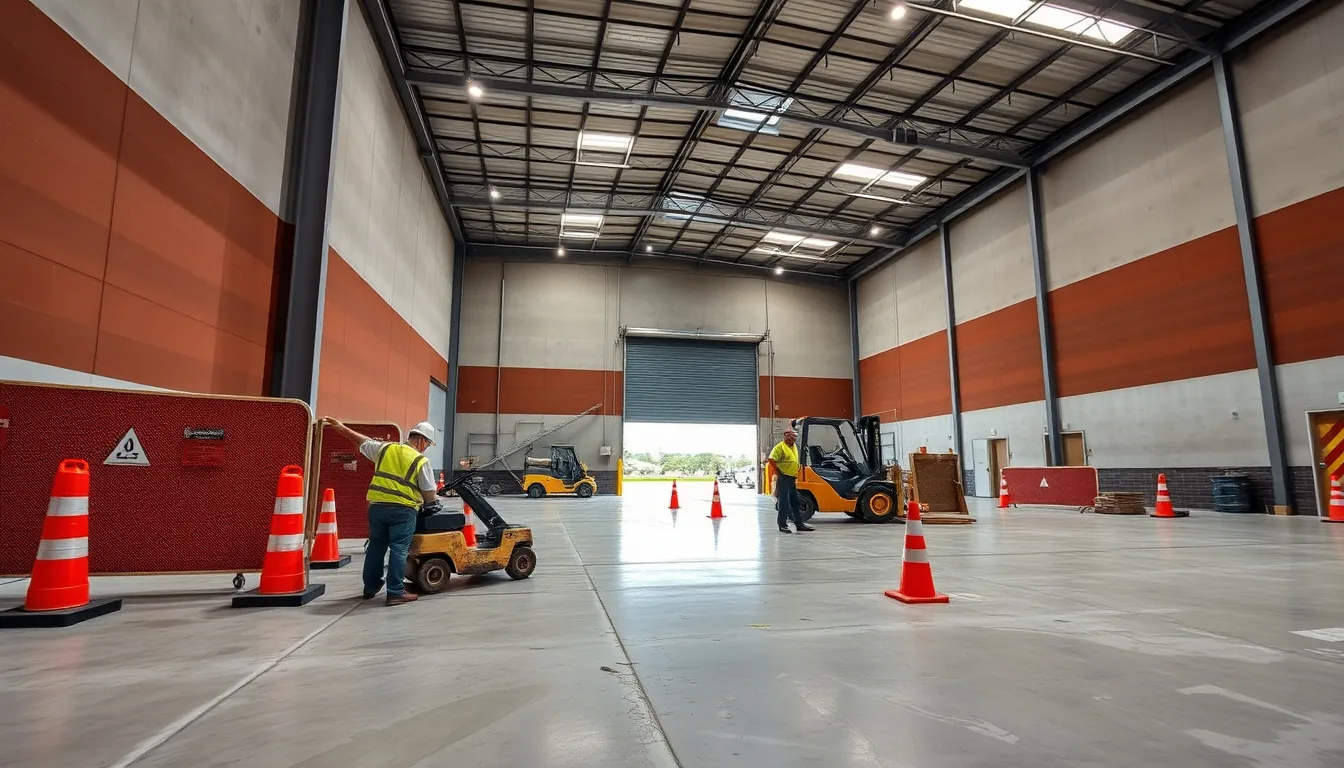
COMMERCIAL & INDUSTRIAL LEVELING
Commercial Concrete Lifting in Arizona — Warehouse Floors, Loading Docks, Sidewalks & Drive Lanes, With Minimal Downtime
Foam cures in about 15 minutes, so we lift a forklift aisle or storefront walkway overnight and hand it back at full capacity by morning — no slurry cure, no week-long closure, statewide across Arizona.
Who We Serve: From I-10 Distribution Centers to HOA Common Areas
Metro Phoenix is one of the hottest industrial construction markets in the country, with millions of square feet of new warehouse and distribution space rising along the I-10 corridor from Tolleson through Buckeye and down toward Casa Grande. Those buildings sit on engineered fill — compacted well, but still fill — and the flatwork around and inside them settles at joints, aprons, and trenches as that fill consolidates.
We lift and stabilize concrete for the full commercial spectrum: warehouse and distribution floors, retail centers and storefront walkways, HOA common-area sidewalks and pool decks, municipal facilities, school campuses, and healthcare properties where a level walking surface is not optional. Whatever the property type, the deliverables are the same: measured lifts, logged injection volumes, and dated documentation your facility file can stand on.
The common thread is that commercial concrete cannot come out of service for long. Tear-out and re-pour closes an aisle or an entrance for a week or more. Our work is measured in hours, and most of it can happen while your facility is dark. That single fact changes settled concrete from a capital disruption into a routine overnight maintenance item on the calendar.
The Downtime Argument: 15 Minutes to Cure, Not 3 Days
The math that sells commercial foam lifting is not the price per square foot — it is the cost of the closure. Polyurethane reaches roughly 90 percent strength in about 15 minutes, which means a forklift aisle injected at midnight carries full traffic at 6 a.m. Old-style mudjacking slurry needs 24 to 72 hours before load; demolition and re-pour takes an aisle out for a week or more, plus cure time.
For a distribution operation, that difference is the difference between a maintenance line item and a lost shift. For a retail center, it is the difference between a walkway leveled before opening and caution tape across your tenant's storefront during business hours. Multiply that across a season of storefronts and aisles, and cure time becomes the biggest number in the repair decision.
We schedule around your operation, not ours — nights, weekends, holiday shutdowns, between-shift windows. The equipment is truck-mounted and self-contained, hoses run long, and there is no slurry mess to wash down when we leave. Crews stage away from operations, work areas are coned and released section by section, and your team gets a completion walk-through before the morning shift starts.
Trip Hazards, ADA, and Legal Exposure: The 1/4-Inch Problem
Under the 2010 ADA Standards, any vertical change of 1/4 inch or more in a walking surface is a trip hazard. Edges between 1/4 and 1/2 inch pass only if beveled at 1:2, and anything over 1/2 inch requires re-leveling or a ramp. Every raised sidewalk flag on your property is a measurable, photographable lawsuit vector — and plaintiffs' attorneys measure.
Arizona law sharpens the point. Phoenix City Code §31-55 makes the abutting property owner — not the city — liable for injuries caused by defective sidewalks along their frontage, and §31-57 lets the City perform the repair and bill the owner who does not act. Scottsdale, Tempe, and Mesa carry similar ordinances. For a commercial property, a settled public-facing walkway is direct legal exposure sitting in plain view.
The economics are lopsided: lifting a raised flag costs a few hundred dollars, while one trip-and-fall lawsuit or a city-ordered repair bill costs orders of magnitude more. Proactive leveling, documented with dated before-and-after measurements, is the cheapest legal defense a property manager can buy. It also reads well to tenants and their customers, who notice level walkways without ever knowing why.
Warehouse Floors: Stopping the Rocking Slab Cycle
Inside a warehouse, the enemy is the rocking slab. A void forms under a panel edge — from fill consolidation, a washed-out joint, or a plumbing trench settling — and every forklift pass rocks the slab on that void. The rocking pumps fines out from underneath, the joint edges pound each other and spall, and the problem accelerates with every pallet moved.
Rocking joints are usually a void problem, not a failed-concrete problem, and the fix is injection: we fill the void, stabilize the panel so it stops moving, and the pounding stops immediately. That protects more than the floor — it protects forklift wheels and axles, racked product, and the operators absorbing the jolt at every joint crossing all shift.
Caught early, stabilization costs a small fraction of joint reconstruction. Caught late, spalled joints need mechanical repair before the aisle runs smooth again — so the moment your operators start complaining about a bump, that is the cheap moment to call. We can usually inspect, quote, and stabilize a newly reported problem joint within the same week, before the spalling starts.
Loading Docks, Dumpster Pads, and Drive Lanes: Heavy-Load Work
Exterior commercial flatwork takes the hardest service life in Arizona. Dock aprons absorb trailer landing-gear loads and daily truck traffic; dumpster pads take repeated point loads from collection trucks; drive lanes channel both traffic and storm water. And every monsoon season — June 15 through September 30 — flash flows scour base material out from under drive lanes, curb lines, and dock aprons across the state.
We match the material to the load: high-density, heavy-load-rated foams engineered for truck traffic go under docks and lanes, filling the washout voids and re-establishing uniform support before the slab cracks under an unsupported span. A settled dock apron that bangs every trailer, or a drive lane dip that pools water against a building, is typically corrected in a single overnight window.
Because the foam is closed-cell and waterproof, the next monsoon cannot dissolve it or wash it out — which is precisely the failure mode of cement slurry and of re-compacted base in Arizona storm conditions. Once the washout path itself is corrected — a scupper extension, a regraded swale — the repaired apron stays supported through the very storms that created the problem.
ADA Compliance Programs: Survey, Prioritize, Lift, Document
For property managers, HOAs, and facility directors responsible for miles of walkway, we run trip-hazard programs on an annual cycle rather than waiting for incident reports. The output is a documented paper trail that demonstrates due diligence — the thing you want in the file before anyone ever falls. The survey data also builds a year-over-year settlement history for the property, so budget forecasting gets easier every cycle.
HOA-dense East Valley communities in Gilbert, Chandler, and Queen Creek carry particularly large common-area walkway portfolios, and their boards carry the legal exposure that comes with them. A standing annual program turns that exposure into a scheduled, budgeted maintenance item. Boards and managers get a fixed annual number instead of surprise repair invoices, emergency work orders, and the far larger costs that follow a documented fall.
- Annual walking survey measuring every vertical edge against the 1/4-inch ADA threshold
- Prioritized hazard list — worst edges and highest-traffic paths first
- Pinpoint lifting of individual flags, typically back within tolerance in minutes each
- Dated lift log with before-and-after measurements for your facility records
- Re-inspection cadence timed after monsoon season, when new settlement appears
Statewide, Licensed, and Scheduled Around Your Operation
We are ROC-licensed for commercial concrete work under Arizona's C-9 classification scope, which covers repairing, grouting, and sealing concrete — and we carry that license number on every proposal. Vetting a contractor's ROC status takes two minutes on the registrar's site, and we encourage every facility manager to do it before letting anyone drill their floor.
Dispatch is statewide: Phoenix metro and the I-10 industrial corridor, Tucson, Flagstaff, Prescott, Yuma, and the Casa Grande–Maricopa growth corridor between the metros. Night and weekend scheduling is standard for occupied facilities, and multi-site portfolios can be sequenced under one program with consistent documentation across properties. A single point of contact and one reporting format cover the entire map, from metro Phoenix to the state line.
Injection volumes are logged on every job, lift heights are measured and recorded, and you get the documentation whether it is one dock apron or a forty-building walkway survey. That paper trail is what turns routine maintenance into demonstrable due diligence, and it costs nothing extra — measured, logged work is simply how we run every commercial job, large or small.
Get a Commercial Assessment and Fixed Quote
Commercial work starts with a walk-through: we measure settlement, sound for voids, flag every edge past ADA tolerance, and map the monsoon drainage paths feeding the problem. You get a prioritized scope with fixed pricing and a downtime plan matched to your operating hours — before any drilling is scheduled. Walk-throughs typically take under an hour for a single building and scale up from there for multi-site portfolios.
Whether it is one rocking warehouse joint in Tolleson, a storefront walkway in Tempe, or an HOA's entire common-area inventory in Queen Creek, the assessment is free and the numbers are firm. Send plans, photos, or an RFQ, or book the walk-through directly — most commercial assessments are scheduled within the week. Night and weekend work windows are available from the very first visit onward.
Commercial & Warehouse Floors FAQs
Straight answers before we drill
Any vertical change of 1/4 inch or more in a walking surface is a trip hazard under the 2010 ADA Standards. Edges between 1/4 and 1/2 inch must be beveled at 1:2, and anything over 1/2 inch requires re-leveling or a ramp. We lift sidewalk flags back within tolerance and document the correction with dated measurements for your facility records.
The abutting property owner. Phoenix City Code §31-55 makes owners liable for injuries caused by defective sidewalks along their property, and §31-57 lets the City perform the repair and bill the owner who does not act. Scottsdale, Tempe, Mesa, and other Valley cities have similar ordinances — proactive leveling is dramatically cheaper than a trip-and-fall lawsuit or a city work order.
Almost none. The foam cures to roughly 90 percent strength in about 15 minutes, so we can lift a warehouse aisle, storefront walkway, or drive lane overnight and hand it back at full load capacity by morning. Compare that with 24 to 72 hours for mudjacking slurry cures, or a week-plus closure for demolition and re-pour.
Yes — rocking joints are usually voids under the panel edge, not failed concrete. We inject foam to fill the void and stabilize the slab so it stops pumping and spalling at the joints, which protects forklifts, product, and operators. Caught early, stabilization costs a small fraction of joint reconstruction and is done in an overnight window.
Sunken concrete? Get it lifted this week.
Free estimates statewide. Most residential lifts finished in under a day — driveable in 15 minutes.