Soil Science — Statewide Arizona
Arizona Soil & Caliche Settlement Solutions — Why Desert Ground Sinks and How We Fix the Concrete on Top of It
Arizona concrete doesn't fail like concrete elsewhere, because Arizona ground doesn't behave like ground elsewhere. Understanding the soil under your slab is the difference between a repair and a repeat.
The four reasons Arizona ground moves
Nearly every settled slab we lift traces back to one of four soil mechanisms, and knowing which one you have determines the right fix. Collapsible alluvial soils compact suddenly the first time they're wetted. Caliche hardpan makes slabs bear unevenly — rock-solid under one corner, soft pocket under the next. Expansive clay pockets swell and shrink with moisture, heaving edges seasonally. And regional groundwater withdrawal has sunk entire basins, occasionally cracking them into earth fissures.
National franchise content treats all settlement the same. It isn't — and on this page we'll walk through each mechanism the way we assess it on your property.
Collapsible soils: firm for decades, gone in one wetting
Most of the Valley and Tucson basin sits on alluvial fan deposits — sediment carried off the mountains and laid down loose over millennia. Dry, these soils are deceptively strong: particles lock together in an open structure held by clay bridges and a little cemented salt. Add water and the bridges dissolve; the structure collapses and the ground surface literally drops.
This is why the most common settlement story in Arizona starts with 'the slab was fine for fifteen years.' It was — until a new drip line, a re-routed downspout, a slab leak, or one violent monsoon delivered the first real soaking that soil had ever seen. First-wetting collapse is also why brand-new landscaping so often precedes a sunken patio by a year or two.
Caliche: the desert's fake bedrock
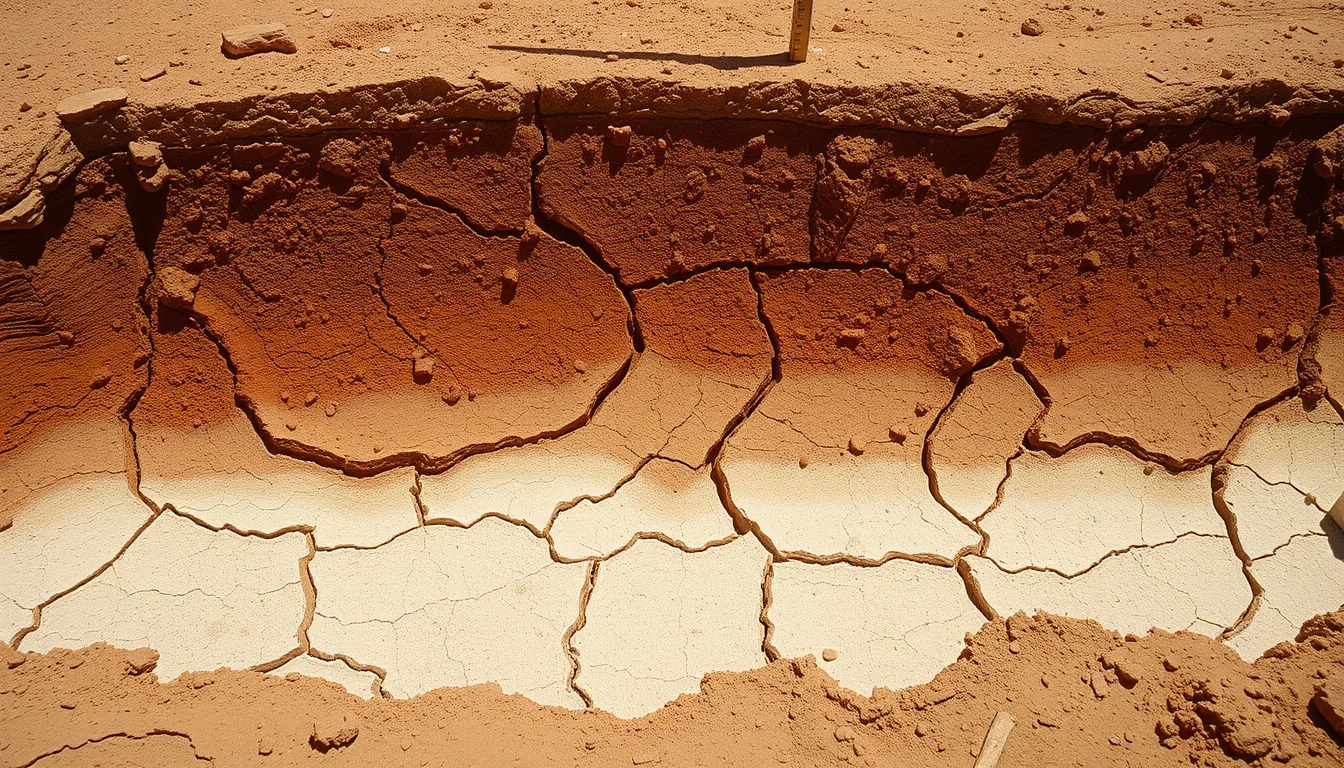
Caliche is a natural hardpan — soil grains cemented by calcium carbonate into layers that can be as hard as lean concrete. It underlies huge areas of Phoenix and Tucson at varying depths, in lenses and ledges rather than a neat continuous sheet.
For a slab, that's the problem. Concrete poured across a hard caliche ledge on one side and a soft pocket on the other settles differentially — one corner never moves, the opposite corner drops an inch, and the slab cracks along the stress line between them. Caliche also makes excavation brutal, which quietly doubles the real cost of tear-out-and-replace estimates. Lifting the existing slab sidesteps the digging entirely.
Expansive clays and seasonal heave
Parts of metro Phoenix and the Tucson foothills sit on pockets of expansive clay that swell when wet and shrink when dry. Slabs on these soils don't just sink — they cycle: edges heave in wet winters, drop through the dry spring, and open working cracks that let monsoon water deeper into the profile.
The tell is movement that partially reverses with the seasons. The fix pairs precision lifting with moisture management — consistent perimeter drainage, joint sealing, and irrigation discipline — so the clay stops cycling under the corrected slab.
Subsidence and earth fissures: the regional story
Decades of groundwater pumping have measurably sunk more than 3,000 square miles of Arizona. The Arizona Geological Survey maps 26 earth-fissure study areas covering roughly 1,400 square miles, with about 169 miles of confirmed fissures across Maricopa, Pinal, Pima, Cochise, and La Paz counties. Near Wenden, the ground has dropped 5.6 feet since 1991.
Perspective matters: the overwhelming majority of settled slabs have nothing to do with fissures. But if your property sits in a mapped study area — parts of Queen Creek, the Casa Grande–Eloy corridor, Willcox — we check the AZGS hazard viewer as part of scoping, and we'll tell you plainly when what you're seeing is bigger than a slab repair.
Matching the fix to the soil
Soil-aware repair is mostly about weight and water. Polyurethane foam at about 2 pounds per cubic foot adds essentially no load to soil that just demonstrated it can't carry load — while mudjacking slurry at 100-plus pounds per cubic foot re-burdens it. Deep injection can consolidate loose fill below the immediate slab base when voids run deeper than a standard lift.
And every job gets the co-prescription: fix the water. Seal the joints, redirect the scupper, shorten the irrigation runtimes, extend the downspout. On collapsible ground, drainage correction isn't an upsell — it's the half of the repair that makes the other half permanent.
- Lightweight foam lifting for slabs on collapsible or backfilled soil
- Deep injection for void networks and loose fill consolidation
- Joint and crack sealing on every job
- Drainage and irrigation corrections flagged in writing
- AZGS hazard-viewer check in mapped subsidence areas
What we won't polyjack
Honesty is a service line here. We don't lift slabs across active fissure traces — that's a geotechnical problem, not a foam problem. We don't chase structural foundation failure with flatwork foam; post-tension slab movement and stem-wall issues get referred to a structural engineer. And we don't lift concrete that's shattered past saving, because leveling rubble just gives you level rubble.
When your project is one of those, we'll tell you at the free inspection and point you to the right specialist. The repeat business and referrals that honesty earns are worth more than any single job.
Start with a soil-aware assessment
Every estimate we run starts with the ground, not the concrete: where the water comes from, what the soil profile likely is for your area, what the settlement pattern says about the mechanism underneath. Then you get a fixed price and a plain-English explanation of why the slab moved and why the fix will hold.
Call 844-967-5247 or use the estimate form — statewide, from Phoenix and Queen Creek to Tucson, Flagstaff, and Yuma. This page anchors everything else we do: driveways, pool decks, patios, and commercial floors all sit on the same desert ground.
Soil & Caliche Solutions FAQs
Straight answers before we drill
Most desert valley soils are collapsible alluvial deposits — loose sediment that stands firm while dry, then compacts suddenly when irrigation, a plumbing leak, or monsoon rain first soaks it. Add caliche hardpan bearing slabs unevenly and regional subsidence from groundwater pumping, and Arizona slabs settle differently than anywhere else in the country.
Caliche is a natural calcium-carbonate hardpan common under Phoenix and Tucson. Slabs bearing on hard caliche lenses next to softer pockets settle unevenly and crack — and caliche makes excavation for replacement brutal, which is a big reason lifting beats re-pouring here.
Fissures are ground cracks from basin subsidence caused by groundwater pumping — Arizona has about 169 miles of mapped fissures across five counties. Most settled slabs are not fissure-related, but if your property is in an AZGS study area we check the hazard maps and tell you before recommending anything.
Foundations in fast-growing areas like Queen Creek and Buckeye sit on engineered fill, but driveways, patios, and walks are often poured over utility-trench backfill and loosely returned soil that consolidates in the first 2–7 years. New-build flatwork settlement is the most common call we get.
Sunken concrete? Get it lifted this week.
Free estimates statewide. Most residential lifts finished in under a day — driveable in 15 minutes.