Driveway Lifting — Statewide Arizona
Driveway Lifting & Leveling in Arizona — Fix Sunken, Cracked Driveway Slabs Without Replacement
That dropped slab at your garage apron isn't going to fix itself — and it doesn't need a jackhammer. Precision foam injection lifts Arizona driveways back to level in hours, driveable the same day.
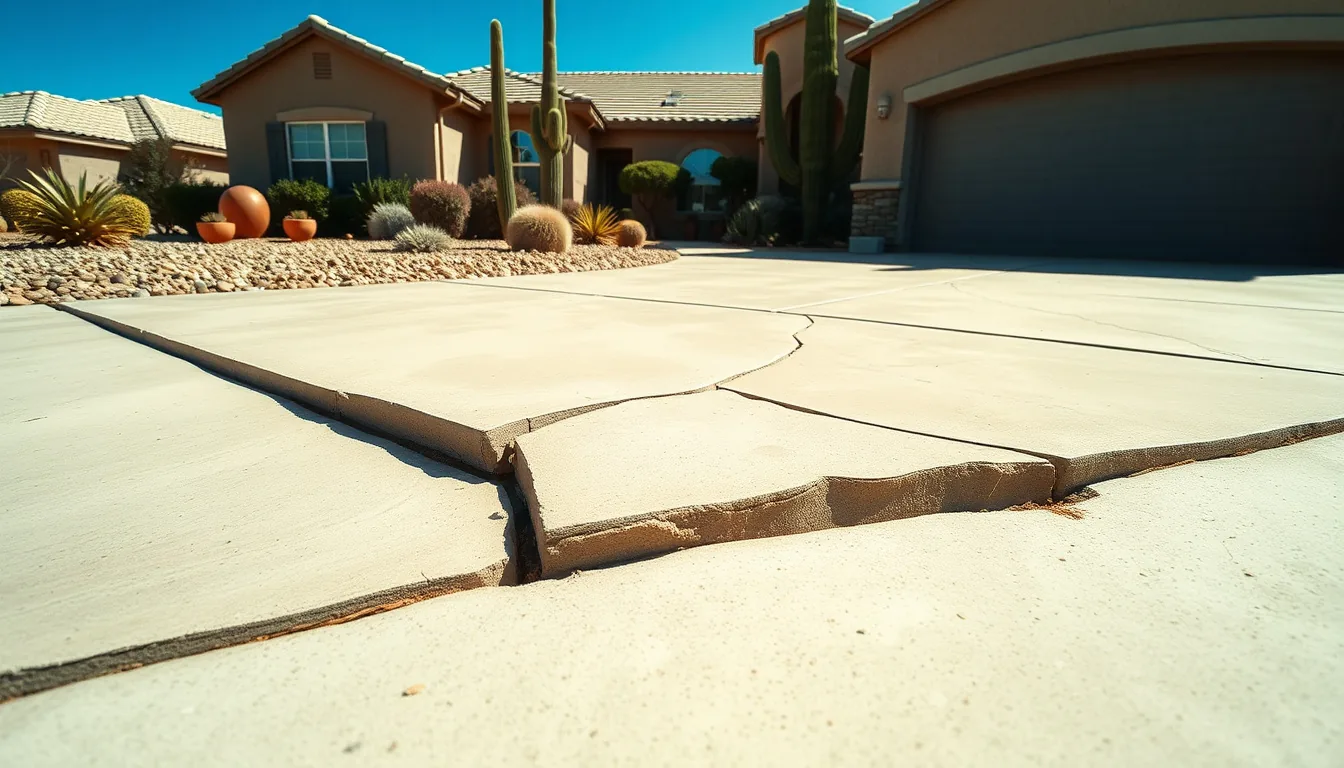
The warning signs every Arizona driveway shows first
Driveways are usually the first concrete on the lot to move. The slab nearest the garage drops half an inch and catches your tire every morning. Joints stair-step where one panel settled and its neighbor didn't. Water stops draining to the street and starts pooling against the garage — or worse, running toward the stem wall.
Left alone, settlement compounds: an open joint lets the next monsoon wash more base material out, the void grows, and a slab that needed a $900 lift cracks into pieces that need replacement. Catching it at the half-inch stage is the cheap version of this repair.
- A step or lip where driveway panels meet — anything at 1/4 inch is already a trip point
- Slab dropped at the garage apron or sidewalk transition
- Cracks that stair-step or radiate from a corner
- Water pooling on the slab or draining toward the house
- A hollow drumming sound when you tap the slab edge
Why Arizona driveways sink in the first place
Most of urban Arizona is built on alluvial fan deposits — loose, wind-and-water-laid sediment that stands firm while it's bone-dry and then compacts suddenly the first time it gets soaked. Your driveway can sit perfectly for fifteen years, then drop the summer a scupper starts discharging at its edge or a drip line gets extended along the border.
New-build neighborhoods have their own version of the problem. In fast-growing communities like Queen Creek, Buckeye, and Maricopa, foundations sit on engineered, tested fill — but the flatwork often doesn't. Driveways get poured over utility-trench backfill and loosely returned lot-edge soil that consolidates over the first two to seven years. That's why a three-year-old driveway in a brand-new subdivision can be more sunken than a 1978 slab in central Phoenix.
How polyurethane driveway lifting works
We map the settlement with levels, then drill a pattern of 5/8-inch holes — about the size of a dime — through the affected slabs. Two-part polyurethane foam is injected under the slab, where it expands and reaches roughly 90% of its strength in about 15 minutes. We lift in small, monitored increments until the slab is back within a fraction of an inch of its original grade.
The holes are patched with color-matched mortar, joints get caulked, and you can drive on the driveway the same day. Most residential driveways are a one-to-three-hour visit with zero demolition, zero haul-off, and no concrete truck in your cul-de-sac.
What driveway leveling costs versus replacement
For a typical two-car Arizona driveway of around 450 square feet, traditional mudjacking runs roughly $1,500–$3,000 and polyurethane lifting roughly $3,200–$7,500, depending on how far the slabs have dropped and how much void the foam has to fill. Most partial lifts — one or two settled panels — come in far below those full-driveway numbers.
Full tear-out and replacement routinely costs two to four times more than lifting, and that's before Arizona's hidden multiplier: excavating through caliche hardpan, hauling debris, days of cure time you can't park on, and a new gray slab that will never match the rest of your flatwork. Lifting keeps the concrete you already own and puts it back where the builder left it.
Foam versus mud on Arizona's weak soils
The old method — mudjacking — pumps a cement-sand slurry under the slab through 1-to-2-inch holes. It's cheaper per square foot, but the slurry weighs over 100 pounds per cubic foot, and it's going on top of the exact soil that just proved it can't carry weight. Mudjacking repairs commonly fail within 5–10 years, and monsoon water can erode the slurry itself.
Polyurethane foam weighs about 2 pounds per cubic foot — roughly 2% of the load — cures waterproof, and doesn't shrink or wash out. On collapsible desert soil, putting the lightest possible material under the slab isn't a luxury; it's the physics of not repeating the failure.
What we fix in the same visit
Lifting the slab without cutting off the water that sank it is half a repair. Every driveway lift includes joint caulking and crack sealing so monsoon rain sheets over the surface instead of feeding the soil below.
- Expansion and control joints re-sealed with flexible polyurethane caulk
- Void filling under the garage apron and sidewalk transitions
- Drainage flags: scupper discharge, downspout splash, irrigation lines feeding the slab edge
- Documented before/after elevation measurements
How long the lift lasts
The foam itself is inert, closed-cell, and waterproof — it doesn't rot, shrink, or dissolve, so the lift is effectively permanent. What can keep moving is the soil, which is why the joint sealing and drainage corrections matter as much as the lift height.
We back driveway lifts with a written warranty and log injection locations and volumes on every job. If a slab needs a touch-up lift because the soil kept consolidating, it's a quick, small-volume visit — not a do-over.
Get your driveway estimate
Send us a couple of photos and your city, or book a free on-site inspection. We measure the actual settlement, sound for voids, and hand you a fixed price before any drilling starts — same-day quotes on most residential driveways across the Phoenix metro, Tucson, and statewide.
Call 844-967-5247 or use the estimate form. If your driveway is fine but your patio or pool deck is moving, we handle those too — one visit, every slab on the lot.
Driveway Lifting & Leveling FAQs
Straight answers before we drill
A typical ~450 sq ft two-car driveway runs about $1,500–$3,000 with mudjacking or $3,200–$7,500 with polyurethane foam, depending on settlement depth and void volume. Partial lifts of one or two panels cost much less — and replacement routinely runs two to four times the cost of lifting.
The same day. Polyurethane foam reaches roughly 90% strength in about 15 minutes, so the driveway is back in service almost as soon as we pack up — versus 1–3 days of cure time for mudjacking slurry.
Fast-growth communities like Queen Creek and Buckeye compact fill carefully under foundations, but driveways often sit on utility-trench backfill and loosely returned lot-edge soil that consolidates in the first 2–7 years. It's the most common call we get from newer subdivisions.
We lift in small, monitored increments precisely to avoid that. Controlled foam injection is far gentler than the settlement that moved the slab in the first place; slabs that are already broken into many small pieces get an honest replacement recommendation instead.
Sunken concrete? Get it lifted this week.
Free estimates statewide. Most residential lifts finished in under a day — driveable in 15 minutes.