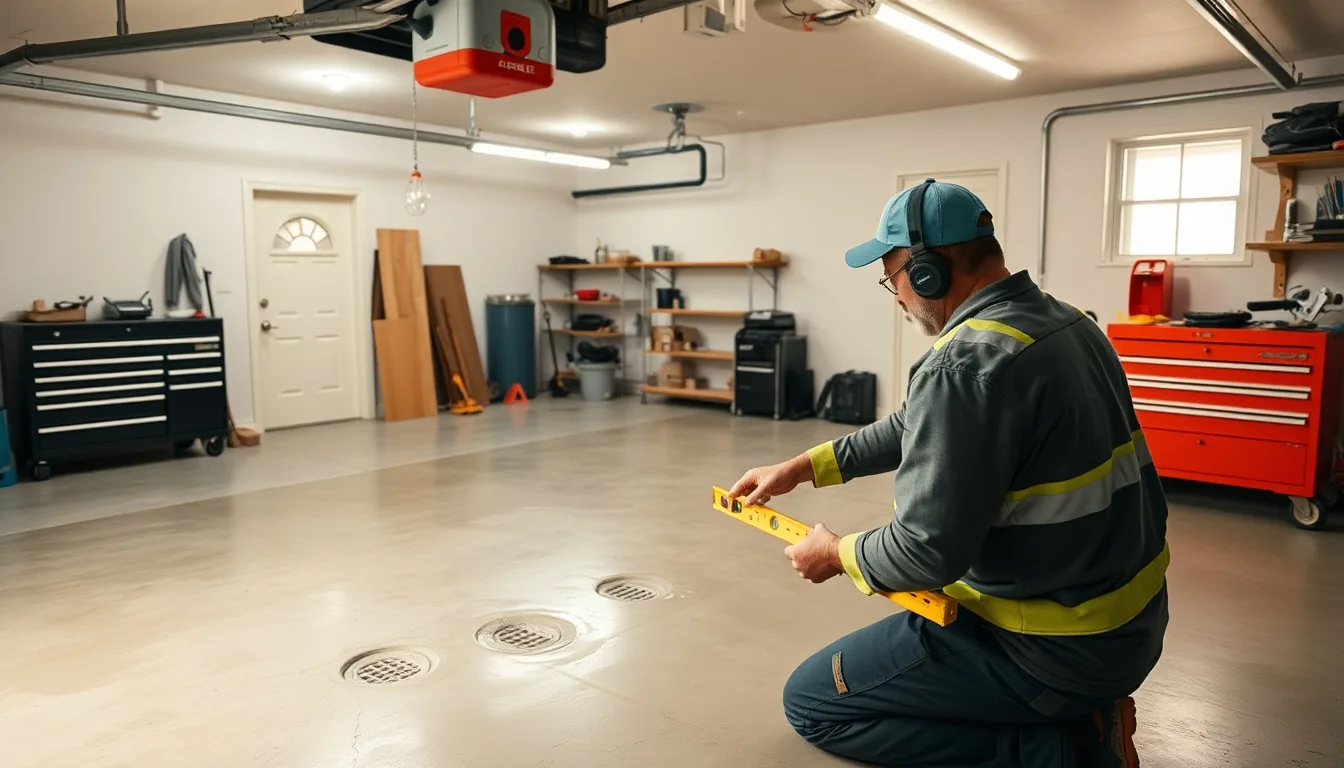
GARAGE & INTERIOR SLAB LEVELING
Garage & Interior Concrete Floor Lifting in Arizona — Level Sunken Slabs Inside the Building Envelope
Arizona homes are slab-on-grade, so every interior floor rides on desert soil. When a garage or interior slab settles, we lift it back through dime-size holes — no slurry, no jackhammer, no torn-up house.
The Signs: How a Settling Interior Slab Shows Itself
Garage slabs announce settlement openly — a crack running corner to corner with one side dropped into a step, a slab that has pulled down and away from the stem wall, water tracking to the low spot when you wash the car. Inside the house, the evidence is quieter and shows up in the finishes first.
Because virtually all Arizona homes are built slab-on-grade with no basements, the concrete under your tile, wood, and carpet is a ground-bearing slab, and it moves when the soil under it moves. Finish symptoms almost always trace back to the concrete below them. A tile crack that keeps coming back after repair, or a door that drifts out of square season by season, is the floor moving — not the finish failing.
- A stepped or offset crack across the garage floor
- Tile cracks that track in a line, following a slab crack underneath
- Interior doors out of square, rubbing, or swinging on their own
- Gaps opening between baseboards and the floor
- Hollow, drummy sound when you tap the floor in a settled area
- A visible gap between the garage slab edge and the stem wall
Floating Slab or Foundation? Getting the Diagnosis Right First
This distinction matters more than anything else on an interior job. In most Arizona homes the garage and interior floor slabs are floating slabs — they sit inside the stem walls but do not carry the structure. When a floating slab settles, the walls and roof are fine; the floor simply dropped, and lifting it is a straightforward, permanent repair.
Foundation movement is a different animal. If the stem wall itself is cracking, if exterior brick or stucco shows stair-step cracking, or if the home has a post-tension slab showing structural distress, the right first call is a structural engineer, not an injection crew. Those are load-path problems, and foam under a floor slab does not solve them.
We inspect for the difference before quoting anything, and we tell you plainly which situation you have. If it is foundation movement, we say so and point you to an engineer. If it is a settled floating slab — which is what we find in the large majority of cases — we can fix it in hours.
Why Interior Slabs Settle in Arizona: Water Under the House
Interior slabs sit on the same collapsible desert soils as everything else in Arizona — loose alluvial deposits that hold shape while dry and consolidate abruptly the first time they are soaked. Outside, monsoon rain does the wetting. Under a house, the water usually comes from somewhere more personal: the plumbing. That difference changes both the diagnosis and the fix.
Arizona's alkaline, caliche-laced soils are aggressive toward the copper water lines that generations of local builders ran under the slab. Pinhole slab leaks wet the sub-slab soil silently, sometimes for months, and the collapsible soil beneath the floor does exactly what it does everywhere else — it collapses. Landscape over-watering against the home's perimeter drives the same mechanism inward from the edges.
Utility-trench backfill is the other repeat offender. The trenches cut for plumbing and electrical under a slab are backfilled by hand and rarely compacted to the standard of the surrounding pad, so slabs settle in lines that trace the trenches beneath them. Extreme garage temperatures pile on, accelerating joint movement and slab curl at the edges.
Why Foam Is the Only Method That Makes Sense Indoors
Picture mudjacking inside a house: a hose pumping wet cement slurry through rooms, 1 to 2 inch holes drilled through your flooring, and a day or more of cure time before the floor can be used. Nobody wants that in a finished home, which is why old-style slurry lifting has never had a real indoor market.
Polyurethane injection was practically designed for interior work. The holes are 5/8 of an inch — small enough to drill through a tile grout line so the tile itself is never touched. The foam travels through a slim hose from the rig in the driveway, expands under the slab, and reaches roughly 90 percent strength in about 15 minutes. Furniture goes back the same day.
Weight matters too. Foam adds about 2 pounds per cubic foot beneath the slab, versus 100-plus pounds for cement slurry. On soil that already failed under load, injecting a hundred pounds per cubic foot of new material is asking for a second settlement — the lightweight fix is the correct fix, not just the tidy one.
What Garage Floor Leveling Costs in Arizona
A full two-car garage floor typically runs about $1,250 to $2,700 with mudjacking or roughly $2,500 to $5,400 with polyurethane foam, depending on how far the slab has dropped and how much void the injection has to fill. Many garage jobs are smaller than that — a single settled crack line or one dropped corner costs a fraction of a full-floor lift.
Compare either number to the alternative: jackhammering out a garage slab, hauling the rubble through your driveway, re-pouring, and staying off the new concrete while it cures — with the finished cost routinely running two to four times what lifting does. And the new slab sits on the same soil that dropped the old one, so nothing about the cause is fixed.
Every quote we give comes from an on-site inspection, because settlement depth and void volume drive the price far more than square footage does. The inspection and the quote are free, and the price is fixed before we drill. If a partial lift solves the problem, that is what we quote — we do not scope a full floor when one corner is the issue.
The Indoor Process: Clean, Contained, and Finished the Same Day
Working inside a home demands a different discipline than lifting a driveway. We contain and vacuum drilling dust at the hole, protect surrounding flooring, and plan the hole pattern around your finishes — through grout lines in tile, in closet corners and along walls where patches disappear, never through the middle of a showpiece floor.
The lift itself is monitored continuously with gauges and a level, raised in small increments so the slab comes up as a plane instead of flexing. When the floor is back to grade, holes are patched with color-matched mortar. In a garage the patches are essentially invisible; in finished rooms we coordinate hole placement with you before drilling so you know exactly where every patch will sit.
If flooring has already been damaged by the settlement — cracked tiles over a slab crack, buckled planks at a step — we level the concrete first so your flooring contractor has a flat, stable base to repair over. Doing it in the other order wastes the new flooring. We are happy to coordinate timing directly with your flooring installer.
After the Lift: Sealing Cracks and Filling Voids at the Stem Wall
A lifted slab with an open crack is a repair waiting to be undone, so we chase and seal slab cracks after lifting to keep water — from a future leak, a mop bucket, or a garage hose-down — out of the soil below. In garages we also seal the joint at the stem wall and the apron joint at the door, the two main water entry points.
Where settlement has left voids extending under the stem wall or the garage doorstep, we fill those in the same visit. An unsupported stem-wall edge concentrates loads it was never meant to carry, and a hollow doorstep eventually cracks and drops. Filling those voids while the equipment is already on site costs little and closes out the problem completely.
If we found evidence pointing to a plumbing slab leak as the water source, we tell you before we lift — fixing the leak first is non-negotiable, because foam under a slab that is still being wetted from above is only half a repair. A leak-detection referral usually settles the question within a day or two, and the lift is scheduled right behind it.
Not Sure If It Is the Slab or the Foundation? Send Us Photos
The fastest way to get an answer is to send photos: the crack in the garage floor, the tile line that keeps cracking, the gap under the baseboard, the door that will not close. We can usually tell you from photos whether you are looking at a floating-slab settlement we can lift in a morning or a structural question that deserves an engineer first — and we will tell you honestly either way.
We handle garage and interior slab lifting statewide, from Phoenix, Gilbert, and Queen Creek to Tucson and beyond. Inspections and estimates are free, the holes are the size of a dime, and the floor is back in service the same day. If your floor is telling you something moved, find out what it is before the next monsoon season adds water to the equation.
Garage & Interior Slabs FAQs
Straight answers before we drill
A full two-car garage floor typically runs about $1,250 to $2,700 with mudjacking or roughly $2,500 to $5,400 with polyurethane foam, and partial lifts of one settled corner or crack line cost much less. Settlement depth and void volume drive the price more than square footage, so we quote from a free on-site inspection with a fixed price before drilling.
About 5/8 of an inch — the size of a dime — patched afterward with color-matched mortar. Indoors we can often drill through tile grout lines so the tile itself is never touched, and we plan hole placement with you before drilling. Mudjacking needs 1 to 2 inch holes, which is one of several reasons slurry lifting is a poor fit inside a home.
Yes — the polyurethane reacts and hardens within seconds of injection, and once reacted it is inert, closed-cell, and waterproof. It does not off-gas into the living space, leach into soil, or absorb water, and the same chemistry is used beneath municipal roads and around buried utilities. It also adds only about 2 pounds per cubic foot to soil that already failed under load.
Fast-growing areas like Queen Creek and Buckeye are built on engineered fill that is compacted for the foundation, but garage slabs often sit partly on hand-backfilled utility trenches and loosely returned soil. That fill consolidates in the first two to seven years — exactly when new-home garage floors start cracking and stepping — and one plumbing leak or a wet monsoon can trigger it all at once.
Sunken concrete? Get it lifted this week.
Free estimates statewide. Most residential lifts finished in under a day — driveable in 15 minutes.