VOID FILLING & SLAB STABILIZATION
Void Filling & Slab Stabilization in Arizona — Fill Washouts and Empty Space Under Concrete Before It Cracks
Arizona's monsoon washouts and collapsible soils hollow out the ground under concrete long before the slab visibly drops. We find those voids, fill them with waterproof foam, and stabilize the slab first.
What a Void Is — and How Arizona Manufactures Them
A void is simply empty space where soil used to be, hiding under concrete that was poured on full support. The slab bridges the gap for a while — concrete is strong in compression but weak in unsupported spans — and then one day a wheel load, a monsoon soak, or plain time cracks it over the hollow.
Arizona produces voids at a rate few places can match. Monsoon flash flows scour base material out from slab edges, curb cuts, and drainage paths every summer. Collapsible alluvial soils consolidate abruptly the first time water reaches them, dropping away from the slab above. Plumbing leaks wash fines into the leak path. Poorly compacted trench backfill settles in neat lines under flatwork.
Add buried organic debris rotting out of old fill and the occasional rodent burrow network under a slab edge, and the ground under Arizona concrete is constantly being edited from below. The concrete on top just has not gotten the news yet. Every one of those mechanisms is active somewhere on a typical Arizona property in any given year, which is why void checks belong in routine maintenance.
Warning Signs of a Hidden Void
The frustrating thing about voids is that the slab can look perfect while sitting over inches of open air. But voids do telegraph, and once you know the signals they are hard to miss — especially in the weeks after a big monsoon cell moves through. Catching the problem at this stage — before the concrete breaks — is the whole game.
The single most reliable test costs nothing: walk the slab and tap it with a rod or drag a chain across it. Supported concrete answers with a dead, solid note; concrete over a void drums hollow. If a section of your driveway, patio, or warehouse floor changed its sound after a storm, something under it changed too.
- Hollow, drum-like sound when tapping or chain-dragging the slab
- Hairline cracks radiating from one area with no visible settlement yet
- A slab edge or corner that suddenly dropped after a storm
- Water from a hose or storm disappearing under the slab instead of running off
- Soil washing out at a slab edge, downspout, or scupper discharge point
- Anthills or rodent activity concentrated along one slab edge
Stabilize Before It Sinks: The Cheapest Repair Is the Early One
Here is the part most property owners learn too late: a void does not mean the slab has sunk yet. There is a window — often a full season or more — between the ground hollowing out and the concrete finally cracking and dropping into the gap. Work done inside that window is stabilization: filling the void while the slab is still at grade and still intact.
The economics are dramatic. Stabilizing a supported, uncracked slab means injecting foam into the void and walking away — no lifting, no crack repair, no replacement of broken panels. Once the slab cracks and settles, the job becomes lifting the pieces, sealing the fractures, and sometimes replacing panels that broke too badly to raise. Early stabilization routinely costs a small fraction of the after-the-crack repair — the difference can be tenfold.
That is why the hollow sound matters so much. It is the only warning most slabs give before they break, and it is the cheapest moment in the entire life of the problem to act. A hollow slab that gets filled this month never becomes next year's cracked-and-settled lifting job, and that difference shows up directly on the invoice.
The Right Foam for the Right Void: Deep Injection to Shallow Fill
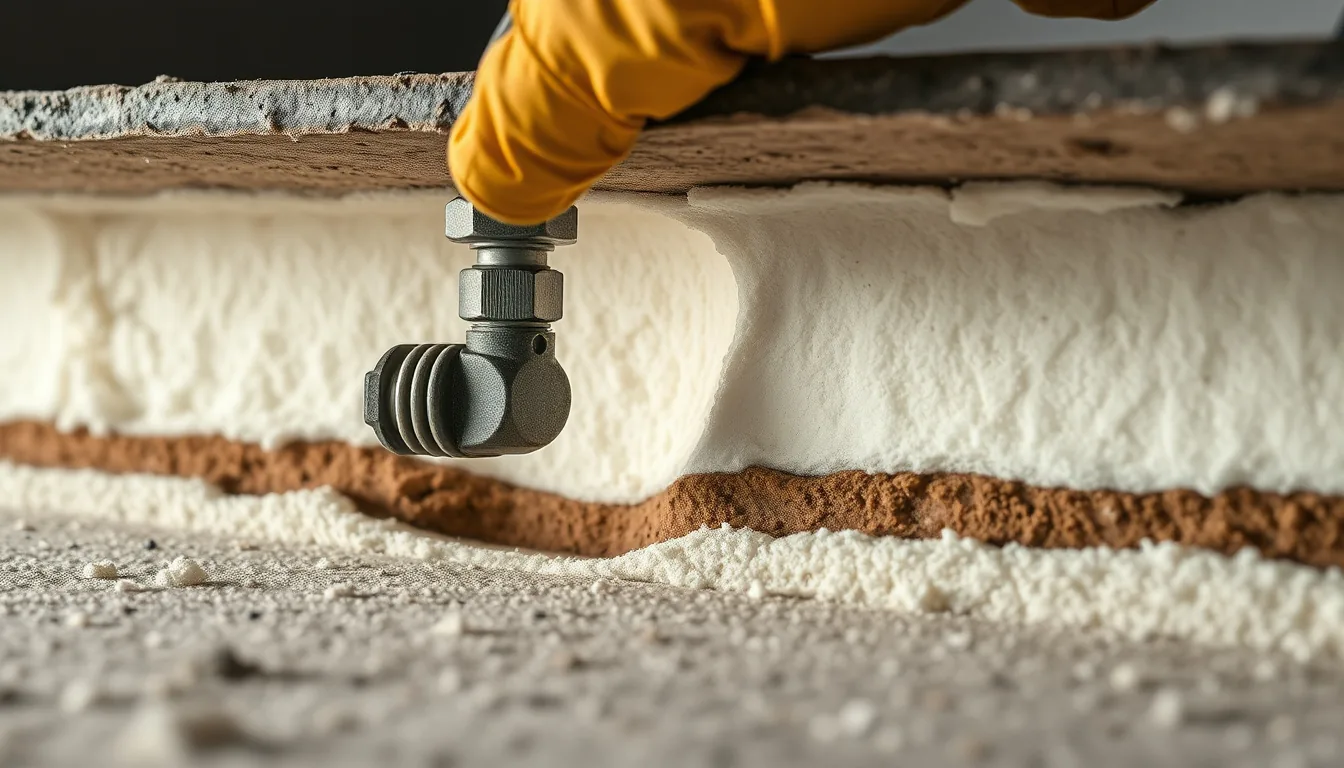
Void filling is not one product — it is a family of polyurethane systems matched to depth and duty. Shallow voids directly under a slab take standard lifting foams injected through 5/8-inch holes, expanding to fill the space and reaching roughly 90 percent strength in about 15 minutes. Deeper, loose zones call for deep-injection resins driven down through probes to consolidate weak soil below the immediate void.
The material fits Arizona's failure mode. At about 2 pounds per cubic foot, the cured foam adds essentially no load to soil that already proved it collapses under weight — unlike cement slurry at 100-plus pounds per cubic foot, which re-loads the weak ground and, being erodible, can wash out in the next monsoon. The polyurethane is closed-cell, waterproof, and inert once reacted: storm water flows past it instead of dissolving it.
We also fill the voids nobody thinks about until they fail: under stem walls where washout has undermined the footing edge, beneath front steps and stoops that ring hollow, and under A/C pads slowly tipping the condenser out of level. Small structures like these fail quietly, and filling under them takes minutes once the injection rig is already on site.
Culverts, Canal-Adjacent Slabs, and Drainage Structures
Arizona moves an enormous amount of water through engineered channels — canals, laterals, irrigation ditches, and storm culverts — and concrete near moving water develops voids faster than concrete anywhere else. Culvert wingwalls and aprons get undermined by scour at every flow event; slabs and drives adjacent to canal embankments ride on soils that see repeated wetting cycles.
The SRP flood-irrigation neighborhoods of Tempe, Mesa, and central Phoenix are a special case: entire yards are deliberately flooded on a schedule, which means the soils around driveways, walkways, and patios in those neighborhoods get saturated dozens of times a year. That regular soaking consolidates collapsible soil and opens voids under flatwork at a pace dry-lot neighborhoods never see.
We fill and stabilize around these structures with the same logged-injection process — including heavy-duty foams under aprons and headwalls that take vehicle loads — and coordinate with irrigation schedules so the repair goes in dry and cures before the next water delivery. For canal-adjacent commercial slabs and culvert work, the injection log doubles as documentation for the irrigation district or municipality.
How We Verify the Void Is Actually Full
Injecting foam blind and hoping is not a method. Every void job starts with investigation: we sound the slab to map the hollow footprint, probe to establish depth where access allows, and mark the injection grid before drilling a single 5/8-inch hole. The mapping stage is what separates a targeted and verifiable fill from an expensive guess made with a hose.
During injection we log material volume at every hole — the foam itself is the measuring instrument, because the volume it takes to reach refusal tells us exactly how much empty space was down there. Gauges and a level watch the slab throughout so a stabilization job stays a stabilization job: the goal is full support at existing grade, not accidental lift.
When the grid is complete we re-sound the entire slab. The drummy notes are gone, the tap comes back solid, and you get the injection log — hole locations, volumes, and before-and-after soundings — for your records. On commercial work that documentation doubles as your dated due-diligence trail. Homeowners get the same log — it transfers with the property at sale.
When a Void Is a Geology Problem: Fissures and Subsidence
Most voids under Arizona concrete are local and fixable — washout, a leak, bad backfill. But this state has a deeper story: decades of groundwater pumping have measurably sunk more than 3,000 square miles of Arizona land, and the Arizona Geological Survey has mapped roughly 169 miles of confirmed earth fissures across Maricopa, Pinal, Pima, Cochise, and La Paz counties, with more suspected.
Ground cracking near a fissure trace is not a foam problem, and pretending otherwise would waste your money on a repair the ground will tear apart. Before we quote void work in known study areas — the Queen Creek and Casa Grande–Eloy corridors among them — we check the AZGS hazard viewer against your parcel. Queen Creek publishes its own fissure guidance for good reason.
If the mapping or the crack pattern points to fissure or subsidence activity, we tell you plainly and route you to geotechnical help first. Most properties check out clean, and then the void work proceeds on solid footing — literally and figuratively. Honesty about the geology costs us a few jobs and saves our clients from repairs the ground would undo.
Post-Monsoon Void Inspections: September and October Are the Season
Every monsoon — June 15 through September 30 — rewrites the ground under Arizona concrete. Roughly a third of Phoenix's annual rain and nearly half of Tucson's arrives in those violent weeks, and every flash-flow event scours base material and triggers first-time collapse somewhere. September and October, when the storms end, are when the new voids are all in place and findable.
That is why we treat early fall as inspection season. A post-monsoon walk-through — sounding your slabs, checking scupper and downspout discharge points, probing suspect edges — catches washouts while they are still stabilization jobs instead of next spring's cracked-and-settled lifting jobs. A typical residential walk-through takes under an hour, and most of what we find can be stabilized the same week.
Inspections and estimates are free, statewide, from the Phoenix metro and Queen Creek to Tucson, Prescott, and Yuma. If your concrete survived another monsoon, let us confirm the ground under it did too — and if a slab has started drumming hollow, call before the next storm finishes the job. Booking ahead of the fall rush gets you the earliest inspection slots.
Void Filling & Stabilization FAQs
Straight answers before we drill
Yes — the June 15 through September 30 monsoon delivers roughly a third of Phoenix's annual rain and nearly half of Tucson's in violent bursts. That water scours base material from under slab edges, funnels down roof scuppers onto flatwork, and triggers first-time collapse of dry desert soils, which is why September and October are the prime months for a void inspection.
Earth fissures are ground cracks caused by basin subsidence from decades of groundwater pumping; Arizona has about 169 miles of mapped fissures across five counties, and over 3,000 square miles of land has measurably sunk. Most voids are NOT fissure-related, but we check the AZGS hazard maps before quoting, and if your property sits in a fissure study area we say so before recommending anything.
The polyurethane is inert, closed-cell, and waterproof — it does not shrink, rot, or wash out, so the fill itself is effectively permanent. At about 2 pounds per cubic foot it adds essentially no load to the soil below, and monsoon water flows past it instead of eroding it the way it erodes cement slurry. If ground keeps moving, the cause is water, and we address that at the same visit.
Once it reacts — within seconds of injection — the polyurethane is inert and does not leach into soil or water; the same chemistry is used under municipal roads, around buried utilities, and beneath drainage structures. It is injected through 5/8-inch holes with no excavation, so lawns, irrigation lines, and hardscape around the slab are left undisturbed.
Sunken concrete? Get it lifted this week.
Free estimates statewide. Most residential lifts finished in under a day — driveable in 15 minutes.