Why Is My Concrete Sinking? The 5 Arizona Soil Problems Under Your Slab
Your driveway sat flat for fifteen years. Then one spring you added a drip line to the planter beside it, a monsoon came through in August, and by October the slab at the garage apron had dropped an inch. Nothing about the concrete changed. Everything about the soil did.
Arizona concrete does not sink for the same reasons concrete sinks in Ohio or Georgia. Five distinct soil problems explain almost every settled slab we see between Phoenix, Tucson, and Flagstaff — and knowing which one is under your concrete determines which fix actually holds.
Collapsible Soil: Fine for Decades, Until It Gets Wet
Most of Arizona's valley floors are alluvial fans — loose sediment carried off the mountains by flash floods over thousands of years and dropped in a hurry. That sediment stacked up dry, with a fragile internal structure something like a house of cards. As long as it stays bone-dry, it carries load just fine.
Then water arrives — a new irrigation zone, a slab leak, a monsoon downpour funneled off the roof — and the card house folds. Engineers call these hydro-compactive or collapsible soils, and the collapse happens on the first serious wetting, not gradually. This is the single most common answer to "why did my concrete sink after all these years?" The soil was never strong. It was just dry.
Caliche: The Desert's Fake Concrete
Dig almost anywhere in the Phoenix or Tucson basins and you will hit caliche — a natural hardpan of soil particles cemented together by calcium carbonate. It can be as hard as lean concrete, and it does not form in neat, level layers. It forms in lenses and pockets.
That irregularity is the problem. A slab poured half over a hard caliche lens and half over a soft soil pocket bears unevenly, and the soft half settles while the hard half holds. The result is the classic stair-stepped crack or tilted slab. Caliche has a second cost, too: it makes excavation miserable, which is a big part of why tearing out and re-pouring concrete in Arizona costs so much more than lifting it.
Expansive Clay: The Slow Seasonal Heave
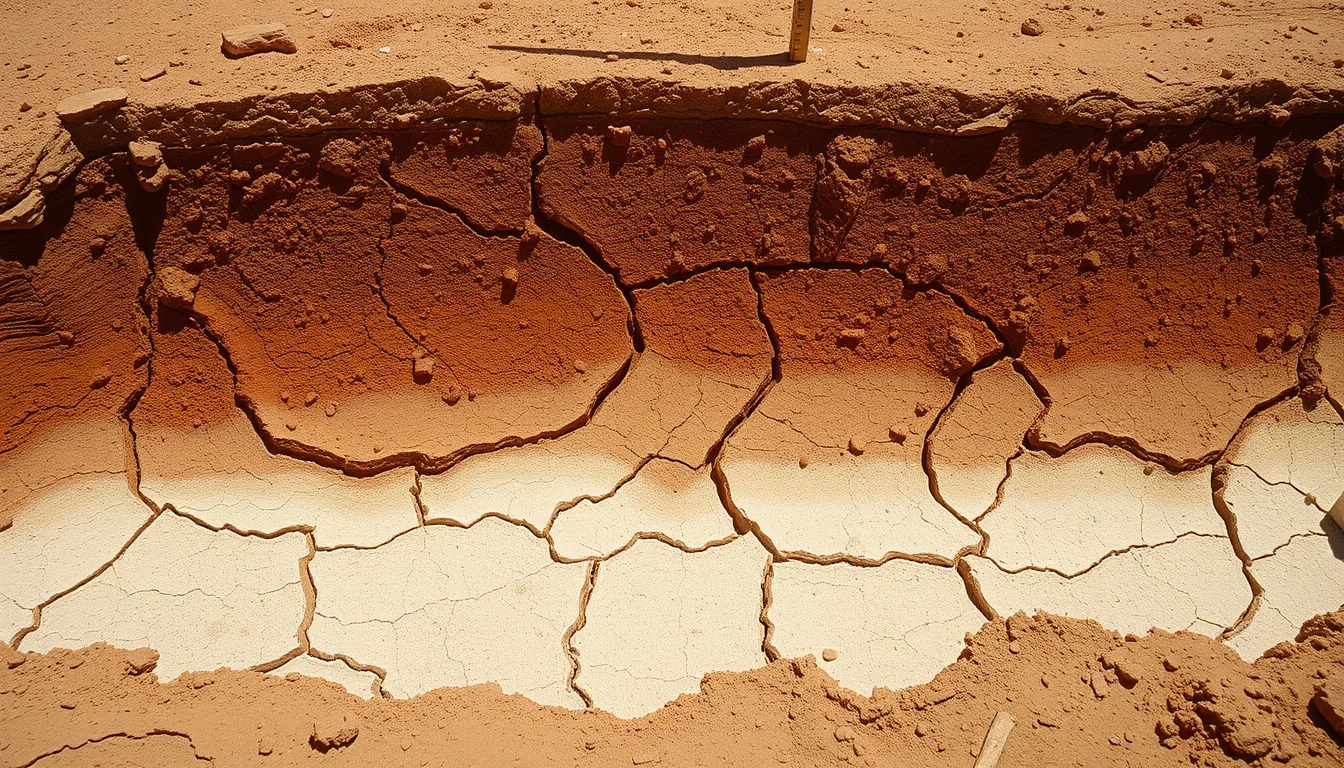
Parts of metro Phoenix and the Tucson foothills sit on pockets of expansive clay — soil that swells when it absorbs water and shrinks as it dries. A slab riding on expansive clay does not just sink; it moves seasonally, heaving in wet winters and dropping through dry summers, opening and closing cracks on a yearly rhythm.
Expansive clay problems announce themselves as movement in both directions. If a slab edge is higher some months and lower others, clay is the suspect, and drainage control matters as much as any lift.
Groundwater Subsidence and Earth Fissures: The Regional Giant
The biggest settlement force in Arizona is invisible from your yard. Decades of groundwater pumping have compressed the state's aquifer basins, and the ground surface above them has sunk. The Arizona Geological Survey reports that more than 3,000 square miles of the state has measurably subsided, with about 169 miles of confirmed earth fissures — open ground cracks at basin edges — mapped across Maricopa, Pinal, Pima, Cochise, and La Paz counties. Near Wenden, the ground has dropped as much as 5.6 feet since 1991.
Perspective matters here: the vast majority of settled slabs have nothing to do with fissures. But if your property sits in a mapped fissure study area — parts of Pinal County, Queen Creek, and the far southeast Valley, for example — that changes the diagnosis. We check the AZGS hazard viewer as part of any inspection in fissure country, and if the map raises a flag, we say so before recommending anything. Lifting a slab over an active fissure trace is not a service; it is a disservice.
Man-Made Causes: Trenches, Leaks, and Irrigation
The fifth problem is us. Human water and human digging cause a huge share of Arizona settlement:
- Utility trench backfill. The trenches cut for water, sewer, and electric lines get backfilled and compacted less carefully than the pad under the house. Slabs poured over those trenches settle along a telltale straight line.
- Plumbing and slab leaks. Copper lines in Arizona's alkaline, caliche-laced soil can corrode and leak, quietly soaking the collapsible soil under interior floors and garage slabs.
- Irrigation and landscape watering. Drip lines and sprinklers along a slab edge deliver the first-wetting trigger, one gallon at a time.
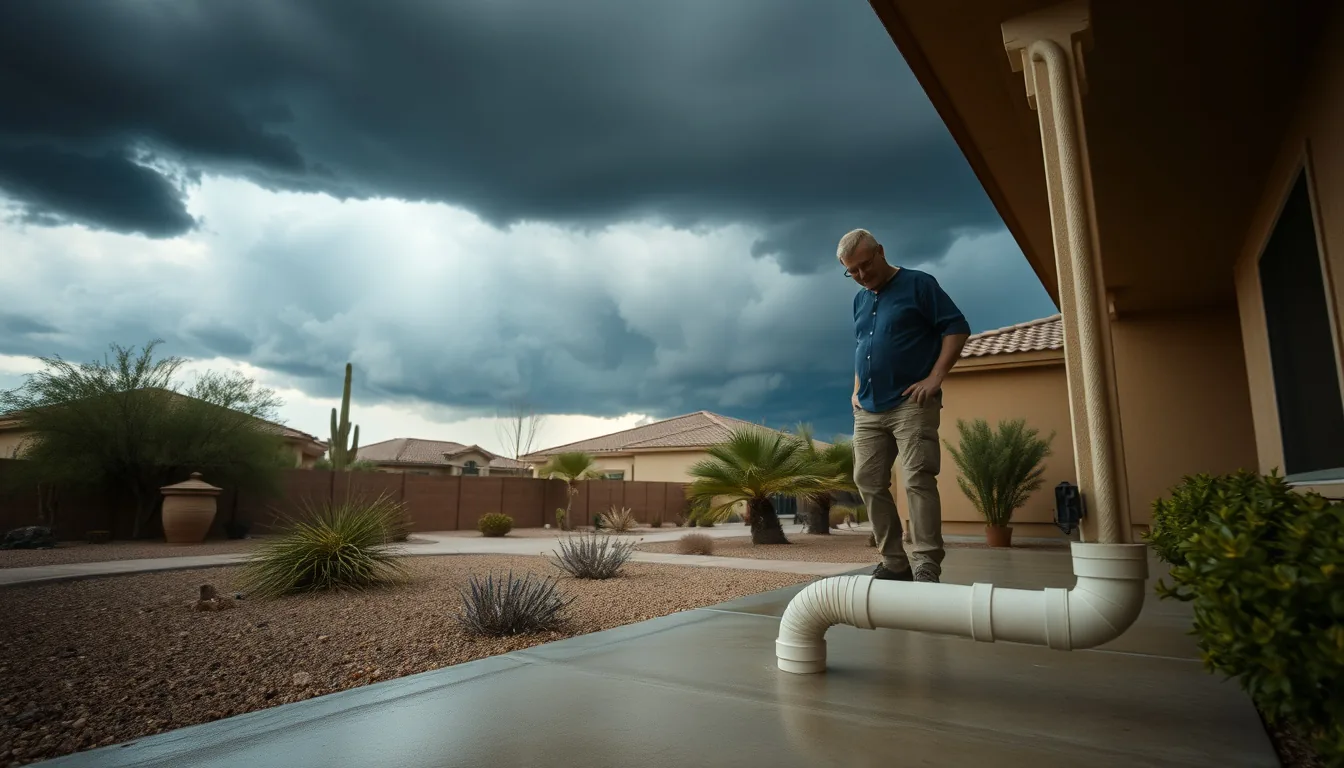
- Roof scuppers and downspouts. Arizona roofs concentrate storm water into a few discharge points, and when those points land beside a patio or driveway, they scour the base out from under it.
A Quick Diagnosis Checklist
Match your symptom to the likely cause:
- Slab dropped suddenly after a storm or a new irrigation zone — collapsible soil, first wetting
- Stair-stepped cracks with one side high and one side low — uneven caliche bearing or trench backfill
- Movement up and down with the seasons — expansive clay
- Straight-line settlement across a yard or driveway — utility trench backfill
- Hollow sound under foot, or water disappearing under a slab edge — an open void from washout or a leak
- Cracks aligned with mapped hazards in Pinal, Queen Creek, or southeast Valley fissure areas — get a professional evaluation before any repair
Matching the Fix to the Cause
The repair only holds if it respects the soil. Lightweight polyurethane foam — roughly 2 pounds per cubic foot, versus 100-plus for old-style mud slurry — lifts the slab without stacking new weight on ground that already failed under load. The foam is waterproof and inert, so the next monsoon cannot dissolve it. Deep injection can consolidate weak fill where the problem runs deeper than the slab base. And every honest repair pairs the lift with drainage work — sealing joints, redirecting scupper discharge, fixing slope — because on Arizona's water-sensitive soils, controlling water is the actual cure.
And when the cause is structural foundation movement or an active fissure, the right fix is an engineer, not a foam rig. We make that referral without hesitation.
Find Out What Is Under Your Slab
A settled slab is a symptom. The diagnosis lives in the soil, and it takes measurements — not a glance from the truck — to get it right. We inspect for free anywhere in Arizona, sound the slab for voids, check the hazard maps where it matters, and tell you exactly which of the five problems you have and what it costs to fix.
Call 844-967-5247 and get a straight answer about what is happening under your concrete.
Ready for a real number?
Free estimates statewide — measured on site, fixed price before any drilling starts.